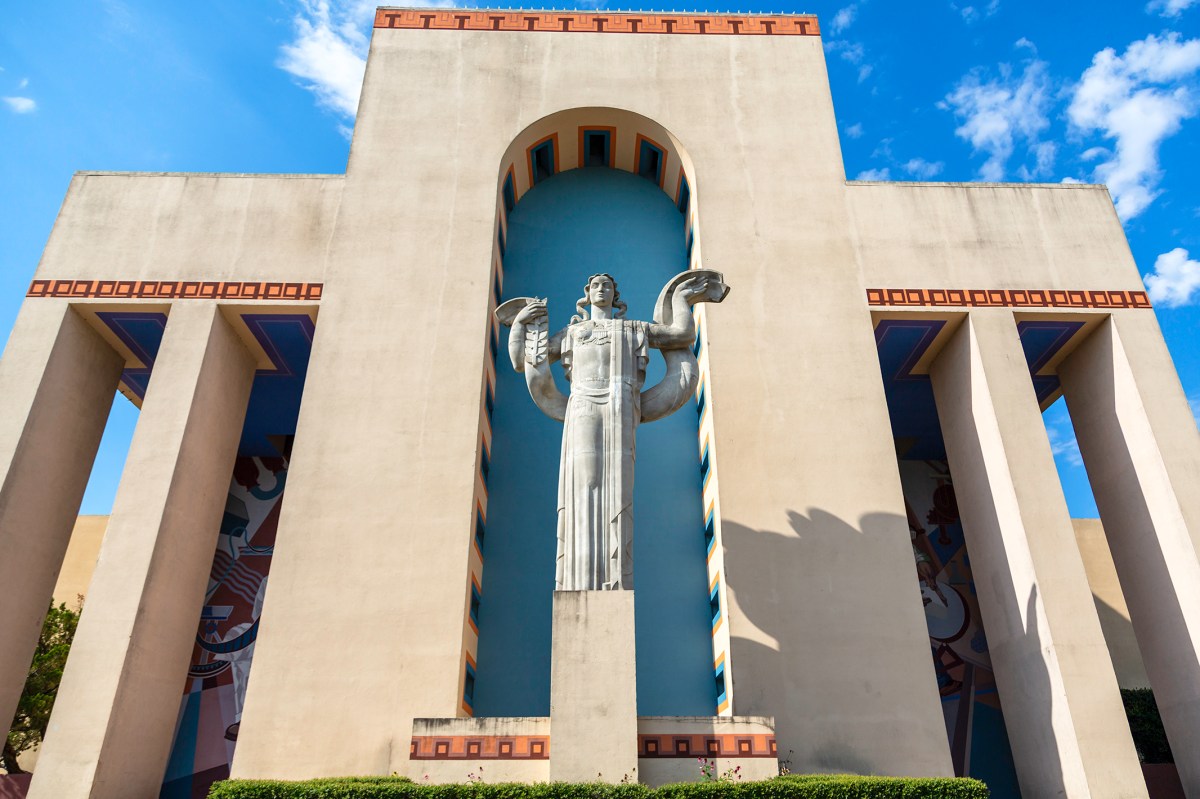
At Fair Park in Dallas, the broads stand guard day and night. And they’re probably judging you—just a little bit.
It is in our nature after all.
I’ve lived in Dallas my whole life (minus two years in Madison for grad school) but never really appreciated this historic landmark until recently. Sure, I’ve attended the State Fair of Texas several times since I was a kid but never once did I closely examine the amazing Art Deco style art and architecture that surrounded me. Instead, I usually just walked around stuffing my stupid face with deadly fried treats while guzzling down mediocre beer like the true patriot that I am.
Well, a few months ago, my husband and I took Frida (the dog, not the artist) on our Sunday morning walk around Fair Park. And as we strolled around the Esplanade, I suddenly realized that a majority of the sculptures in the vicinity are of the female form. How did I miss this detail before?
Obviously, I’m a little slow sometimes. But I do eventually get there.
And since I’ve gotten “there”, I had to learn more! From the Founders Statue to Contralto, let’s get to know these proud women that run Fair Park. But first, we’ll take a quick look at how these monumental sculptures came to be with the Texanic celebration that started it all: the Texas Centennial Exposition.

Designing the Texas Centennial Exposition
As the 100th anniversary of Texas’s independence from Mexico was fast approaching in 1934, state leaders knew the moment had to be met with a new symbol of hope in the middle of Depression-era gloom. And here was the perfect opportunity to not only boost the economy, but also encourage statewide growth, development, and tourism by shining a light on Texas history.
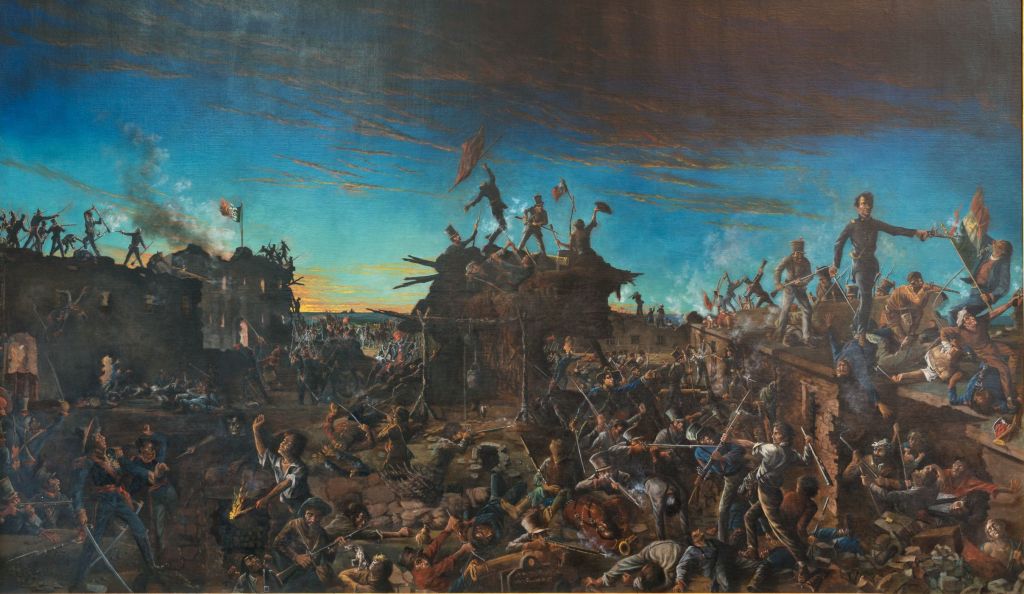
The Texas Legislature created the Texas Centennial Commission that managed celebrations across the Lone Star State and called for city proposals to host the big central Texas Centennial Exposition. After Austin and Fort Worth dropped out of the running, the three largest urban centers in the state—San Antonio, Houston, and Dallas—were the top contenders.
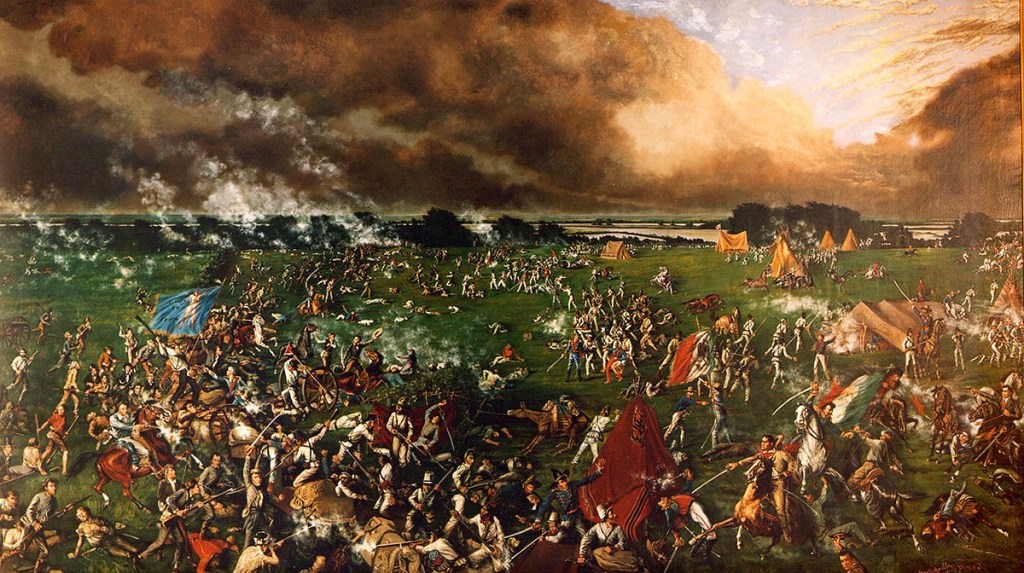
But we know how this story ends. Sure, Dallas didn’t even exist during the Texas Revolution. And sure, San Antonio and Houston might have had glorious revolutionary connections on their side with historical landmarks like the Alamo and San Jacinto Battleground (close proximity anyway), respectively. But you know what we had that they didn’t? MONEY. Robert Lee Thorton, head of the Dallas Centennial Commission, pledged $7.8 million, and Dallas’s bid to host the Texas Centennial Exposition was officially accepted in September 1934.
Once all funding was finalized, exposition leaders finally set their focus on transforming Fair Park for the big Texas-sized event. Dozens of existing State Fair buildings were remodeled while 50 newly designed buildings were on the rise. All 183 acres were set to be landscaped and the installation of several miles of utility lines, sidewalks, and streets would soon seal the deal. And all for the low, low price of an estimated $25 million. That’s exactly what you want to hear in the middle of a Depression, isn’t it?
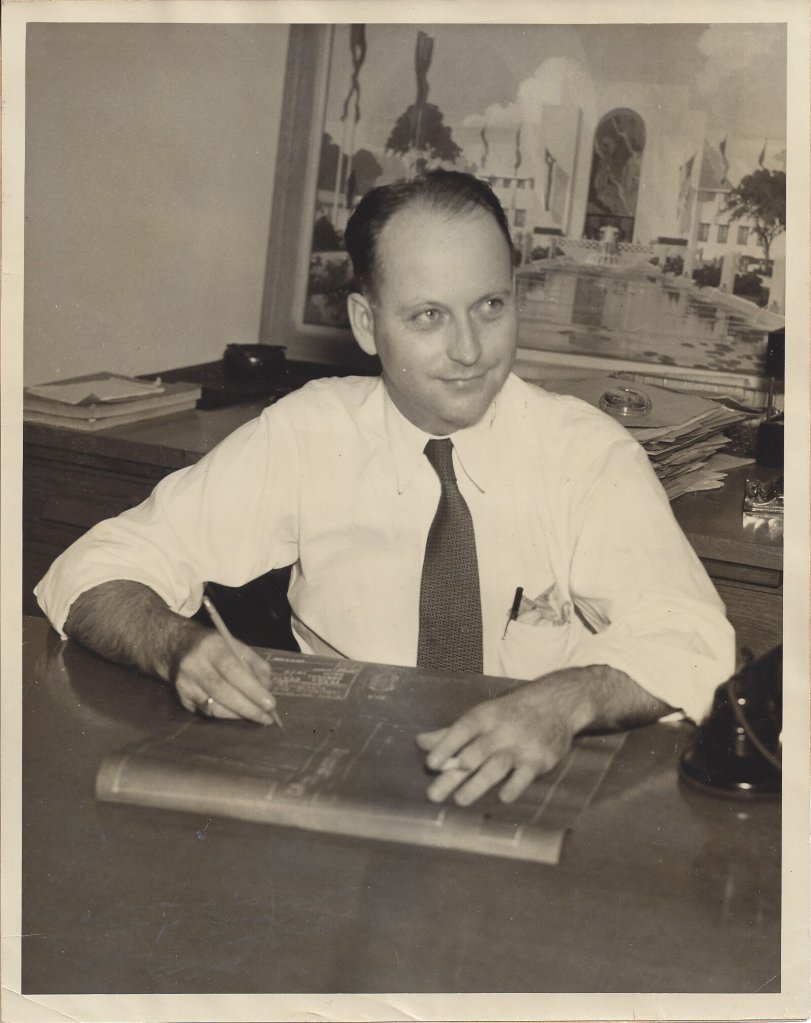
Regardless, the man in charge of delivering the goods was none other than hometown hero George Dahl. He already made a name for himself designing the Neiman Marcus Building and Titche-Goettinger Company Building in downtown Dallas, along with multiple buildings at the University of Texas in Austin. But most importantly, Dahl knew what went into creating an exquisite exposition after attending several world’s fairs across the United States and Europe.
As the centennial architect and technical director, Dahl brought in a dream team of architects, artists, designers, and engineers to help bring his grand vision to life. Several members worked at the 1933 Century of Progress International Exposition in Chicago including artists Raoul Josset, Carlo Ciampaglia, Pierre Bourdelle, and Jose Martin, along with architect Donald Nelson who was brought on as Dahl’s chief designer. Nationally renowned architects Albert Kahn and William Lescaze were also recruited for specific projects, as well as Prix de Rome-winning sculptor Lawrence Tenney Stevens. And finally, architect Paul Phillippe Cret was hired to draw up the master plan for the Fair Park grounds as construction began in the summer of 1935.
Were the local artists of the Dallas Nine pissed off by all these damn out-of-towners dominating their art turf? Of course! But alas, that’s another tale for another day. Though these Texas regionalist artists, including Jerry Bywaters, did assist these higher profile artists.
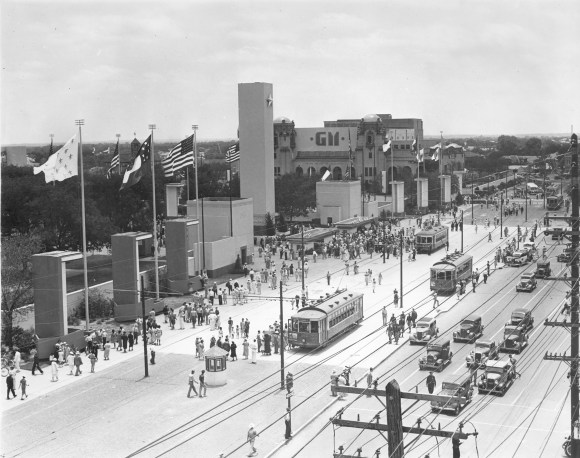
With its pristine landscape, colossal buildings, and bold sculptures, Fair Park soon completely transformed into something magical that the citizens of Dallas had never seen before. In fact, the exposition grounds became known as “Magic City.” Spanish Colonial style (a salute to the architectural heritage of Texas) with a dash of ancient Greek and Egyptian influences served as inspirations for Dahl. Yet, he also had a very stylized, modern approach with a neutral color scheme and simple, clean lines devoid of extravagant ornamentation that screams Art Deco.
The Texas Centennial Exposition opened on June 6, 1936, with the theme: “An Empire on Parade”. Over six million attendees, including President Franklin D. Roosevelt, visited Fair Park from across the nation in complete awe of the magnificent Parry Avenue entrance that lead to the exposition’s majestic exhibition halls, museums, and larger-than-life sculptures during its six-month run. And it’s at the Parry Avenue entrance that we’ll begin our walkthrough of the sculptured women that still watch over the Fair Park in Dallas today.
Founders Statue
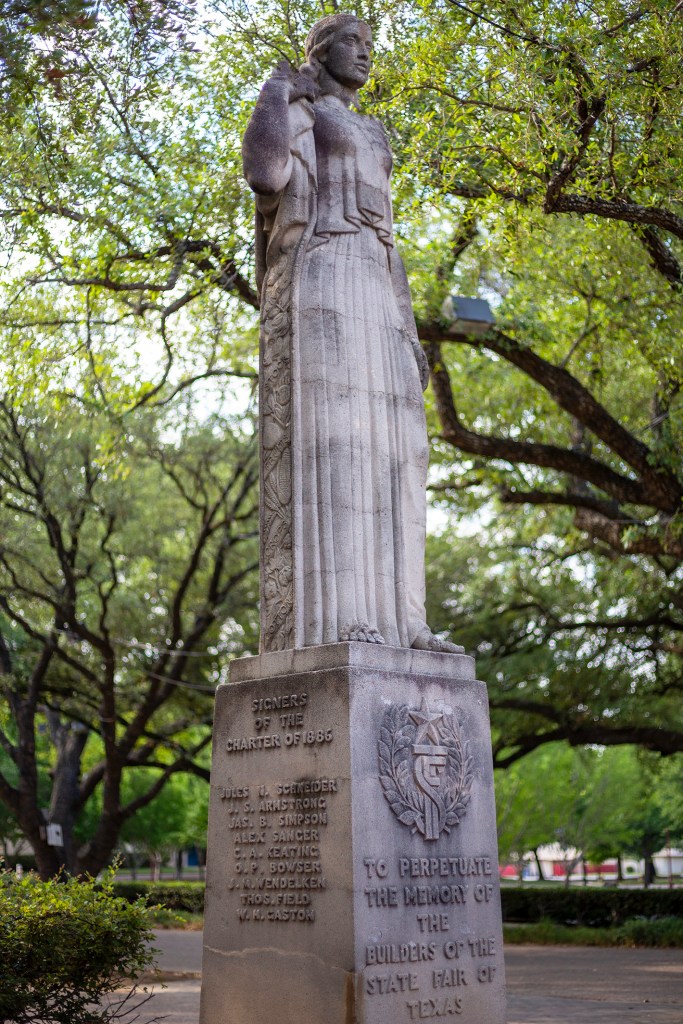
Walk through the Parry Avenue entrance and the first lovely young broad you’ll meet is the Founders Statue.
Okay, she wasn’t originally featured at the Texas Centennial Exposition but was designed by Raoul Josset, Donald Nelson, and Jose Martin, then sculpted by Martin alone in a similar style to the Art Deco sculptures throughout the Esplanade of State produced for the exposition. She confidently stands tall draped in a long flowing dress reminiscent of a powerful Greek goddess.
As a tribute to the founders of the State Fair of Texas, the Founders Statue was unveiled at a dedication ceremony held in honor of the State Fair’s 50th anniversary on October 8, 1938. The concrete sculpture also honored the Texas press that helped to promote the annual celebration. The actual 50th anniversary was in 1936 but the ceremony was postponed for two years due to the Texas Centennial Exposition and the Greater Texas & Pan-American Exposition in 1937.
And here’s a fun fact for you: there’s an iron crypt at the base of this sculpture. The time capsule included State Fair, Texas Press Association, and Dallas Morning News documents, along with 300 newspapers from October 8, 1938. The crypt was to be reopened 50 years later in 1988 but things didn’t exactly work out as planned. State Fair officials soon discovered a leak that developed sometime over the years, and all historical documents inside were destroyed. Needless to say, the official reopening ceremony was canceled.
Spirit of the Centennial
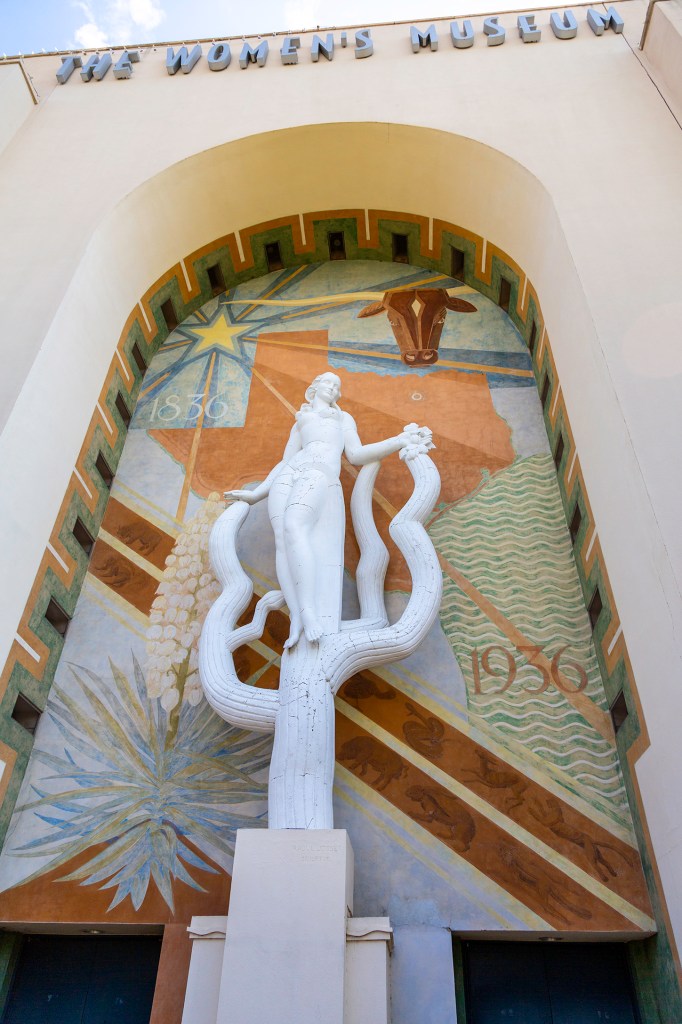
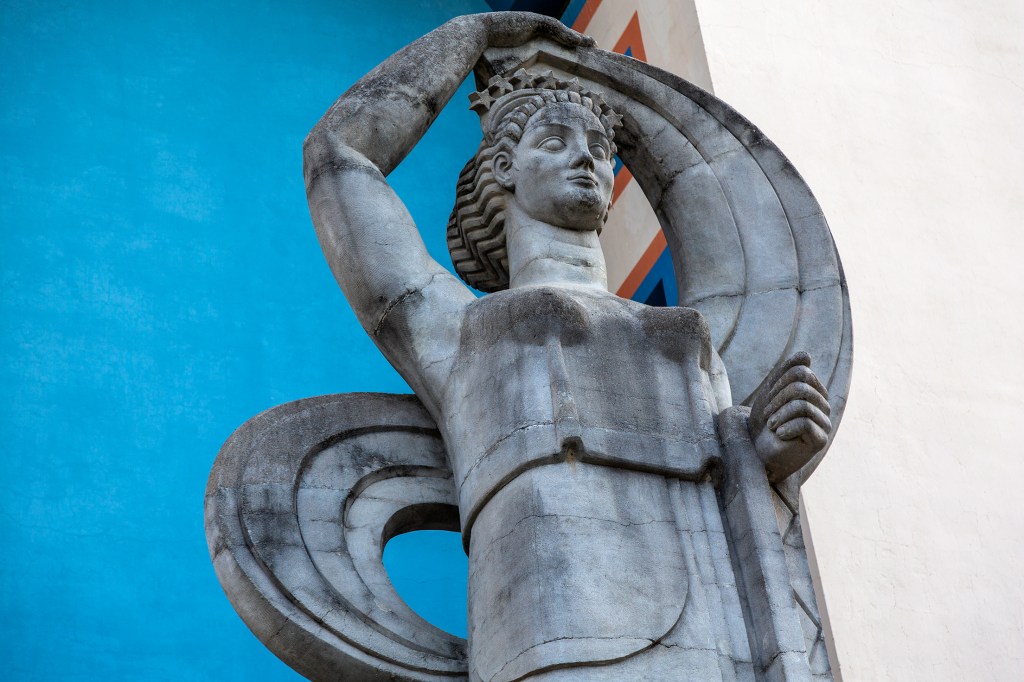
Next on your left, it’s hard not to notice the Spirit of the Centennial that’s at the center of The Women’s Museum. Though at the time of the exposition, this was the Administration Building for exposition staff until architect Wendy Evans Joseph converted it back in 2000.
Designed by Josset and sculpted by Martin, the Spirit often draws comparisons to The Birth of Venus (1486) by early Renaissance painter Sandro Botticelli. But the Texas goddess stands 20 feet tall on a saguaro cactus (that doesn’t actually grow in Texas—but it was all the same to the very French Josset) rather than a seashell. While the saguaro cactus might not be native to Texas, the mural by Carlo Ciampaglia behind the Spirit does depict Texas flora and fauna.
Georgia Carroll, a 16-year-old model from Blooming Grove, Texas, posed for the sculpture after Josset discovered her at a beauty contest. Though it only reflects Carroll from the neck up as she refused to pose nude for Josset because hello: she was underaged. Martin completed the Spirit in just ten days but raced against the clock and was still putting on the finishing touches when the gates opened for the Texas Centennial Exposition that morning.
The Six Ladies of Texas
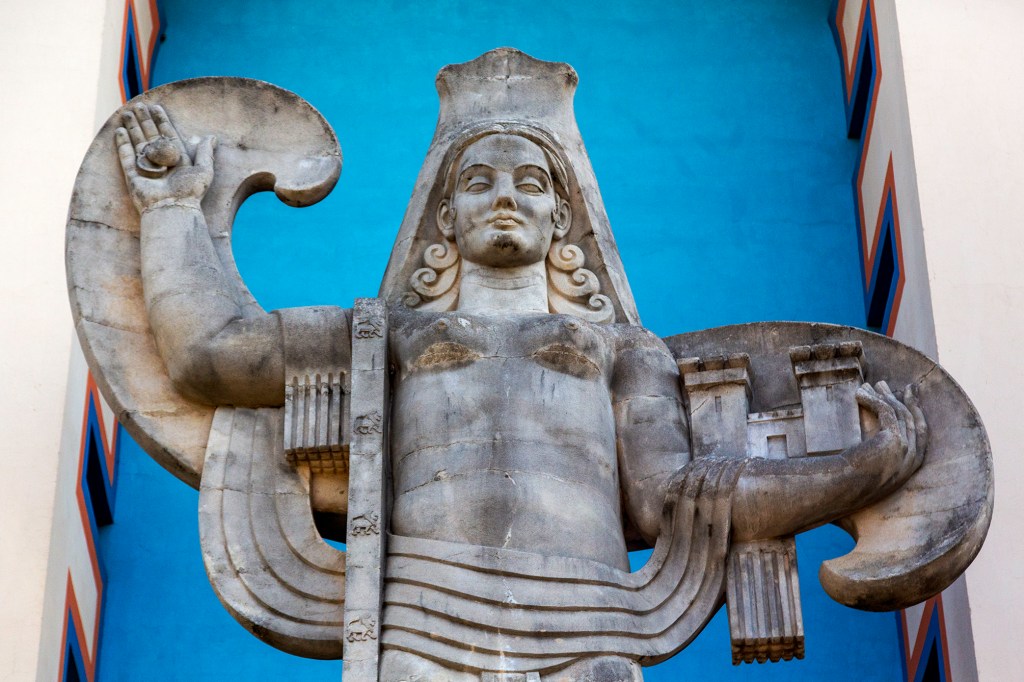
Continue making your way toward the Esplanade of State and you’ll find an alluring 700-foot reflecting pool in the center flanked by the Six Ladies of Texas along the façades of the Transportation and Varied Industries buildings. Each massive 20-foot cast-stone sculpture stands powerfully on 12-foot pedestals in their own niches, each representing the six flags that have flown over Texas.
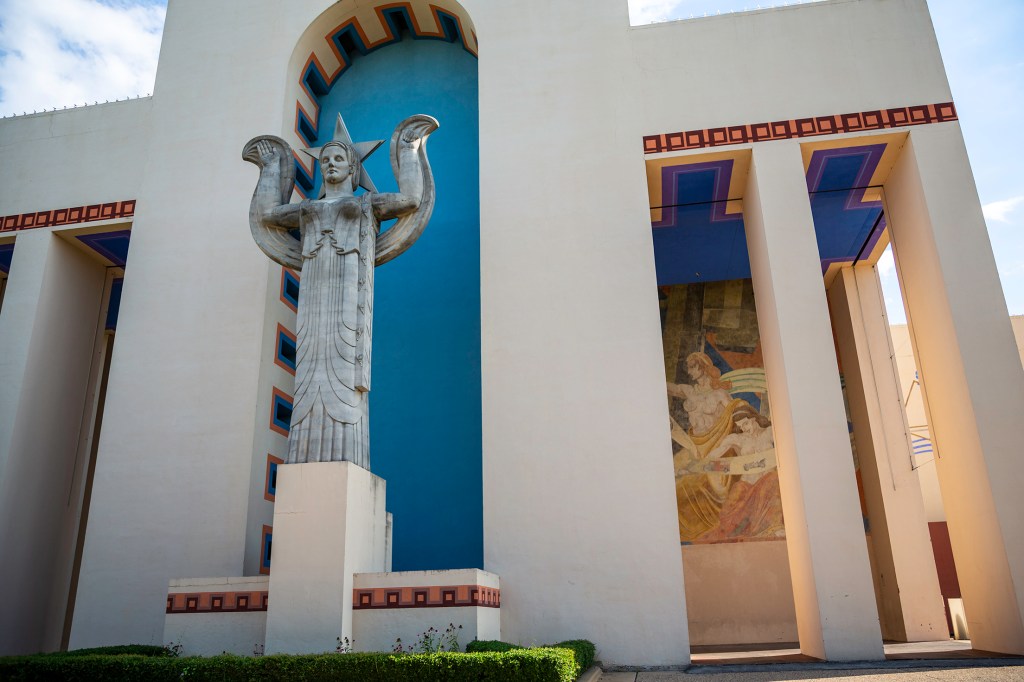
Lawrence Tenney Stevens sculpted Spain, the Republic of Texas, and the Confederate States of America in front of the Hall of Transportation and Josset worked on France, Mexico, and the United States on the other side.
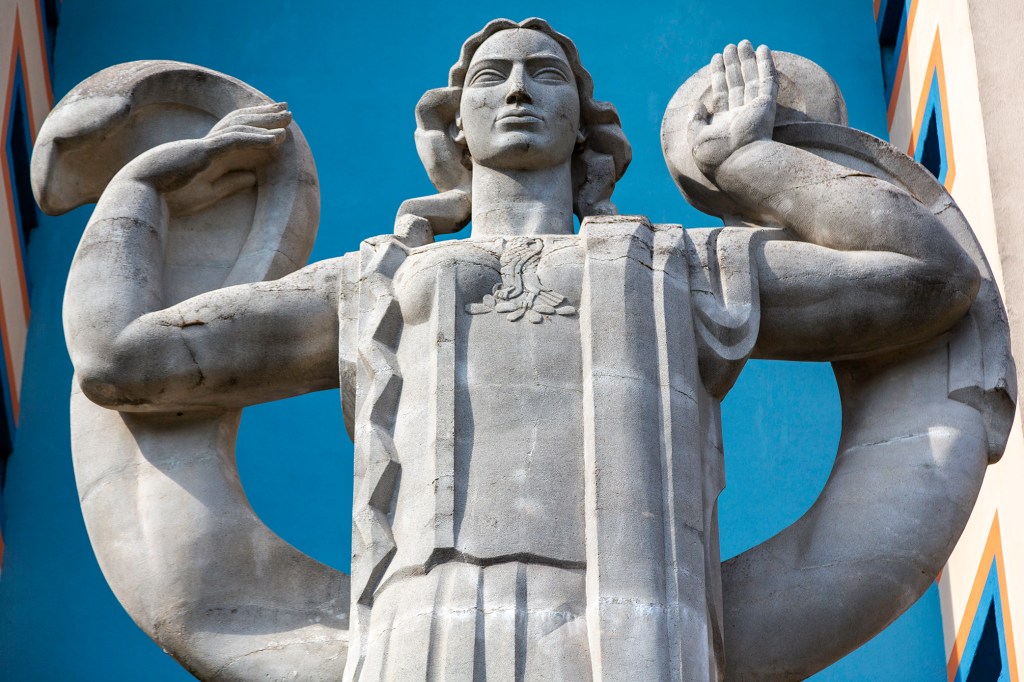
While there are subtle stylistic differences between both sculptors’ work, each striking female figure is outfitted with their respective nation’s symbols. For example, France holds grapes representing their winemaking skills, Spain wears a lace mantilla and holds castanets, and Texas dons a Lone Star behind her head.


Dahl may not have created these six strong ladies, but he did heavily influence their style, proposing they should “be delineated with a vertical expression, draped, executed in a style which might be a concoction of a little of the flavoring of Egypt tempered by the Archaic Greek, and finally breathed over with some of the condiments of the Southern sunshine.”
As far as I can tell: mission accomplished.
Contralto
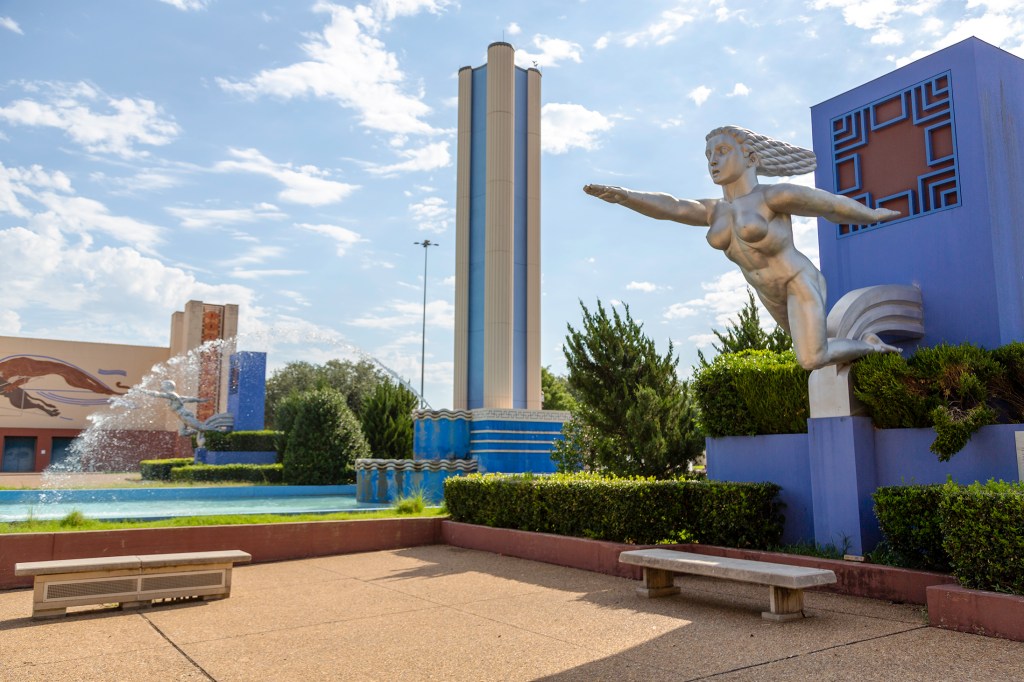
And last but certainly not least, we finally arrive at Contralto (the lowest female singing voice) toward the end of the Esplanade’s reflecting pool to the right of the Great Pylon. Her male counterpart Tenor (the highest male singing voice) is on the opposite side, but we won’t even give that dude the time of day for the purposes of this writing—sorry, dude.
As part of the fountain attached to two “Singing Towers” or the loudspeaker pylons featured at the Fair Park in 1936, Stevens created the silver-painted plaster sculptures to represent sound and celebrate the exposition’s brand-new broadcasting system. But sometime after 1938, the original sculptures were damaged and soon removed because no one wanted to foot the $100 bill to repair them. Where they ended up, we can only speculate but rumor has it that they were melted down for the war effort during the Big One.
But over 70 years later, sculptor David Newton recreated a new set of sculptures that were installed in 2009. Using historic photos of the original Art Deco sculptures as a guide, Newton’s reproductions were cast in bronze this time around and the speaker towers accompanying the sculptures were recreated in cast concrete.
And the oh-so robust Contralto—who looks like she could have jumped right out of a Tamara de Lempicka nude painting—is as daring as ever before. Even gravity is no match for her with bosom and hair alike refusing to fall as she soars forward in harmony with what’s his name on the other side.
Over 85 years after the Texas Centennial Exposition, the Founders Statue, Spirt of the Centennial, the Six Ladies of Texas, and Contralto continue to be as badass as ever. And Fair Park in Dallas wouldn’t be the same without the presence of these formidable women.
 Mariza Morin