I’m back, y’all! Well, sort of. No, I have not written any new art history material. A tiny dictator by the name of Marz rules my life these days. Our world consists mostly of dinosaurs, snacks, and Eric Carle books, which I’m not too upset about.
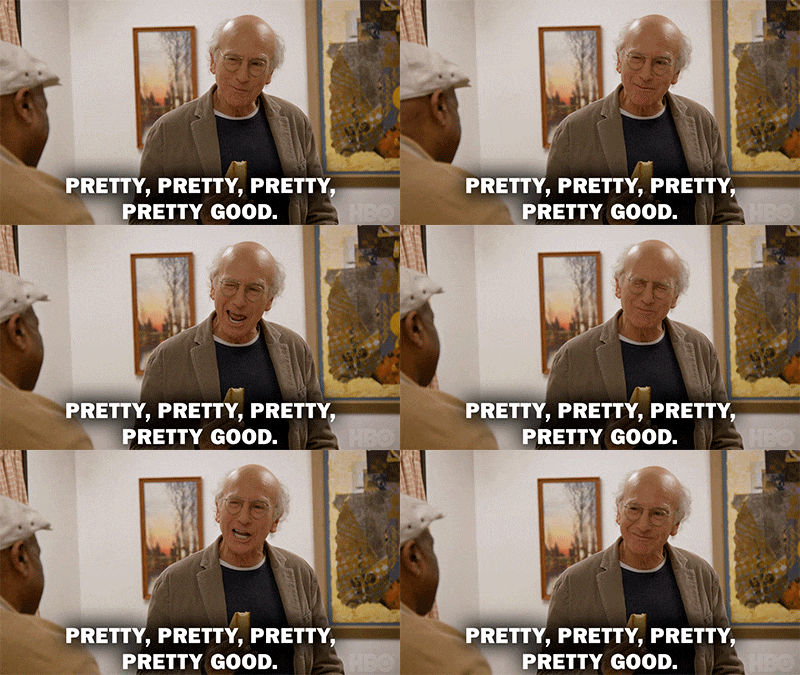
However, I recently learned that the Dallas Public Library’s blog, Booked Solid, is no more. This news was unfortunate for me, considering I wrote some pretty, pretty, pretty good stuff for them as Art Librarian—if I do say so myself.
Larry David approves. Wait, is he in an art museum?
From the history of artists’ books to the brutalist architecture of I.M. Pei’s Dallas City Hall, I wrote several compelling blogs (again, if I do say so myself) for DPL on their notable art collections and local public art between 2019-2021.
From Book as art/art as book: a brief-ish history of artists’ books, written in 2021.
Since I spent so much precious time and energy on each of these glorious art history blogs, I don’t think it’s fair for them to simply vanish into thin air. Therefore, I’m posting them here! No, this is not an April Fools’ joke, fool.
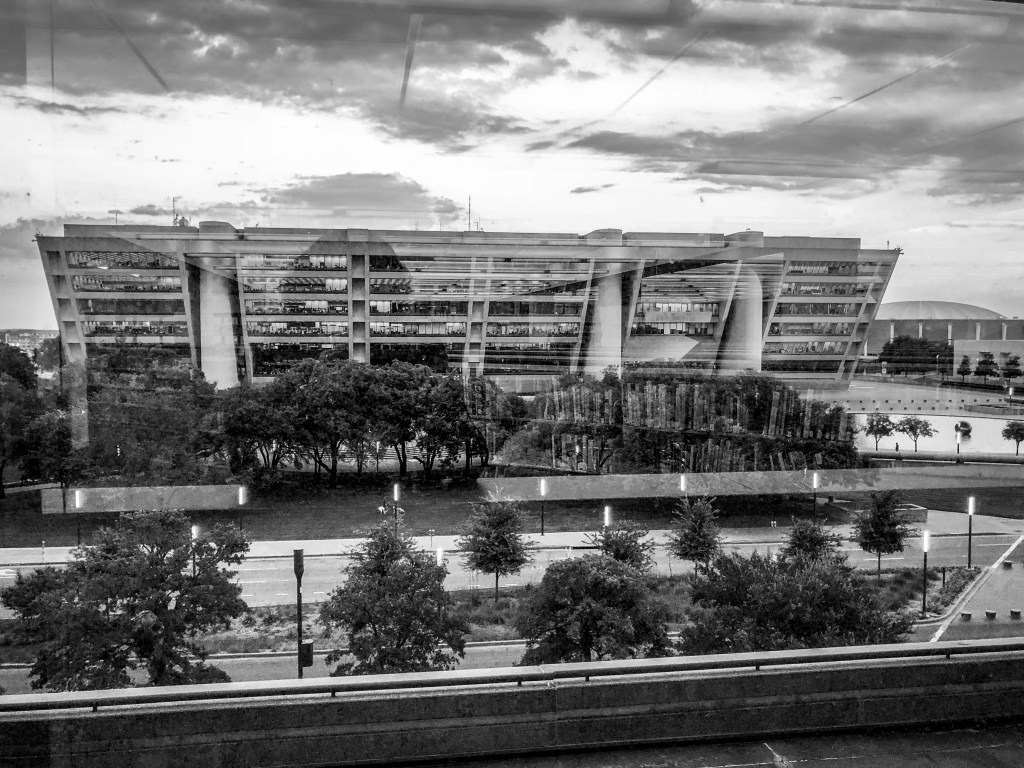
Self-portrait at the Central Library while gazing at Dallas City Hall, 2019.
The plan: I wrote 13 blog posts during my time at DPL, and the goal is to post one per month (if time allows) on this lovely blog. I’ll note the year of publication, context (if needed), and any other changes I might make. Have you ever looked back at something you wrote years ago and immediately hated yourself? Yes, an extra cleanup of each blog post might be in order.
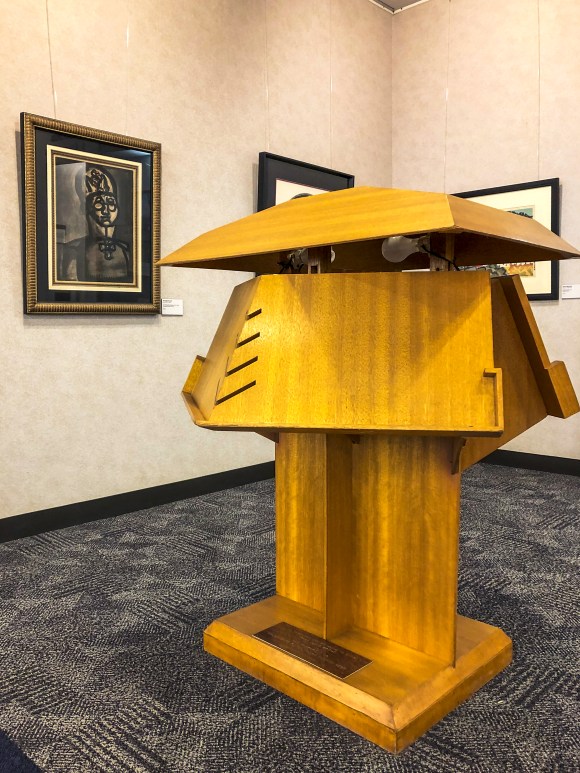
First up—Frank Lloyd Wright’s Music Stand and how the Dallas Public Library accidentally acquired it. Stay tuned!
Frank Lloyd Wright’s Music Stand at Central Library in Downtown Dallas, 2019.
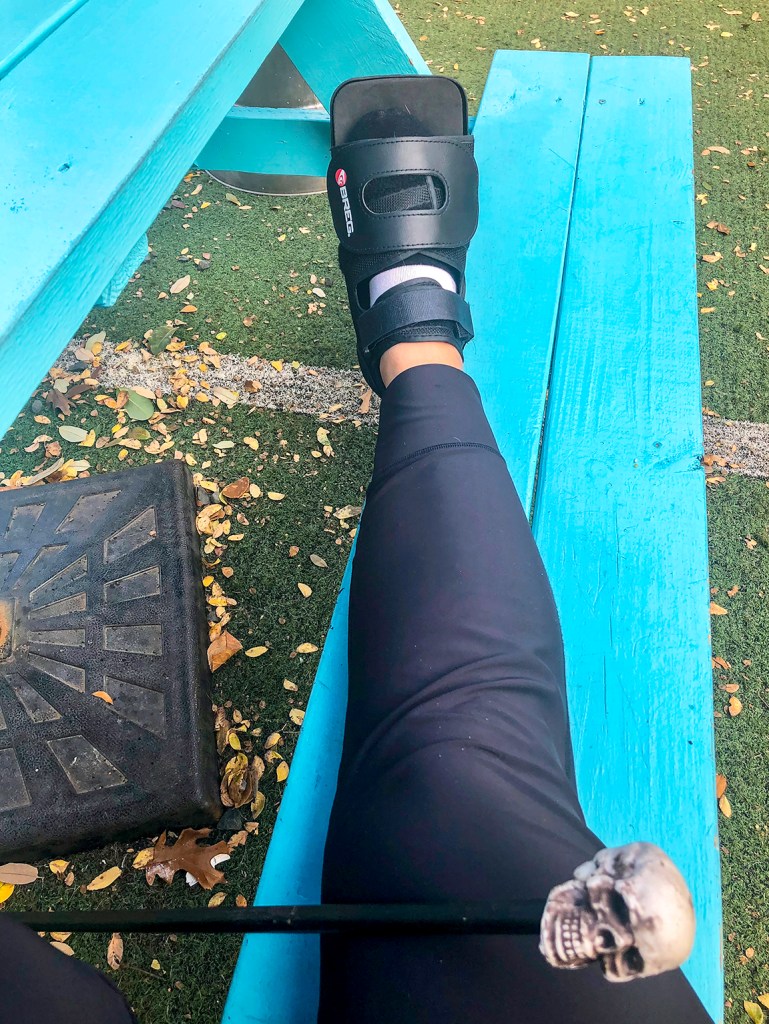
2022 was a great year in comedy. After the two-year shit show that was the pandemic response, I was ready to laugh again. For me, the year actually started in December 2021 when I saw Main Mommy Christina P in San Antonio—with a broken toe. But I was determined! So we trekked down south and I hobbled my way through the LOL Comedy Club with a skull-topped cane in hand. And I was howling by the end of the night! Laughter is, after all, the best medicine.
Booze can help too sometimes.
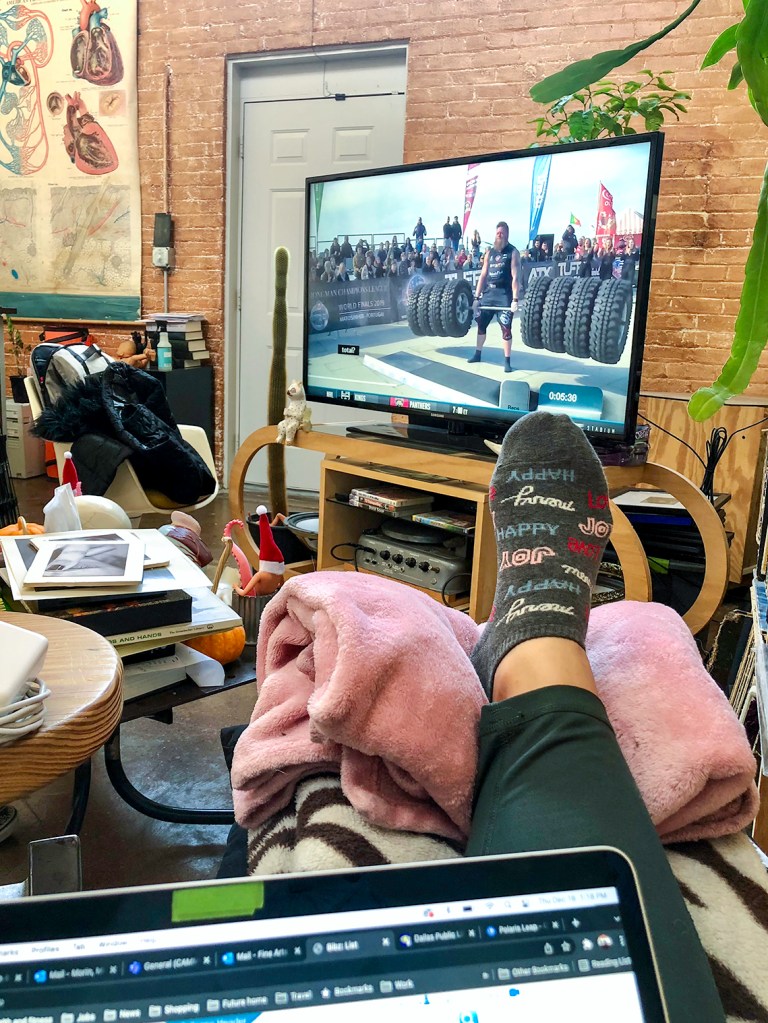
Living my best life with a broken toe, December 2021. Anyone else love Strongman Champions League?
But I kept things local for the actual 2022 year. Starting with Tommy Bunz aka Tom Segura in January, I proceeded to laugh my ass off the rest of the year after seeing the great and powerful Joe Rogan (twice), along with Mark Normand, Jessica Kirson, Brian Simpson, and ol’ freckles himself—Bill FUCKING Burr.
We were supposed to end the year by seeing Ari Shafirr in December but a certain someone in my life shit all over those plans (I still love you though).
And there are plenty more awesome acts on the horizon for 2023! The year already started off with a bang after seeing Tony Hinchcliffe, Chris Estrada, and Sam Morril in January alone. I just saw Shane Gillis last weekend and Steph Tolev last night. Now that bitch is hilarious. I also got Christina P (again!) and Donnal Rawlings coming up soon too so far. Needless to say, I’ve been a little obsessive in my pursuit to laugh. But all this comedic name-dropping is just my long-winded way of saying that I love stand-up comedy—and comedy and humor in general.
Tony Hinchcliffe at the Addison Improv, Jan. 2023. Zalat Pizza deserves a shoutout too.
As an expression of humor, the art of comedy often comes from a place of darkness, pain, and apprehension. And that’s part of the appeal. Comedy and tragedy go hand in hand. Finding humor in a sea of disaster while uncovering some kernel of truth is what it’s all about. Comedy can be contentious and provocative, yet moving and therapeutic all at the same time. Laughter helps us cope with the absurdities of everyday life. It’s also involuntary—making comedy one of the most honest forms of art. It certainly has gotten me through the last couple years of madness.
So I stand by the title: I wanna laugh. Inside joke for all the YMH Mommies out there.
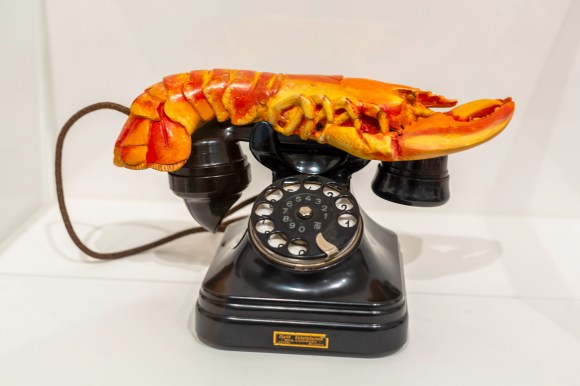
Salvador Dalí, Lobster Telephone, 1938. At the Tate Modern in London.
And as you may already know, I also love studying the history of art. While humor may be fundamental to the human experience, the study of visual humor has largely been ignored by art history scholars. It’s not surprising considering the “serious” and often pretentious nature of the art world—but that’s why I’m here! Your source for stupidly good art history lessons.
Obviously, verbal and visual humor have their differences. While verbal humor is all about timing, usually consisting of stories or observations told bit-by-bit with a punch line at the end, visual humor spills it all at once—and even then it might not always be as apparent as a comedian killing it on stage.
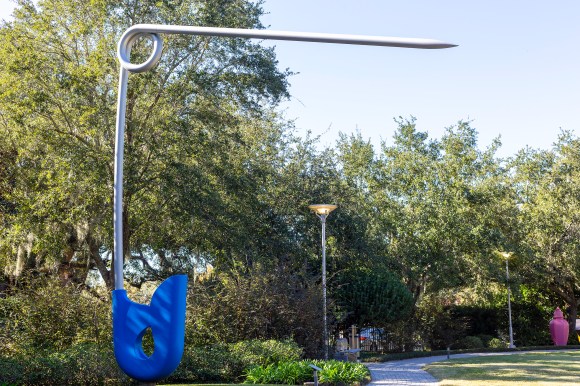
Claes Oldenburg, Corridor Pin, Blue, 1999. At the New Orleans Museum of Art.
But I’ve always been drawn to art that makes me laugh, whether it’s from Marcel Duchamp, Claes Oldenburg, or Jeff Koons and his oh-so-tasteful pornographic aspirations. As I’ve been delving deeper into the world of comedy and humor, I’ve also been asking myself a couple of questions lately as it pertains to this history of art:
Where did visual humor in art start and where is it now?
What was the first visual representation of comedy?
And how can I entwine these two subjects that I hold so dear?
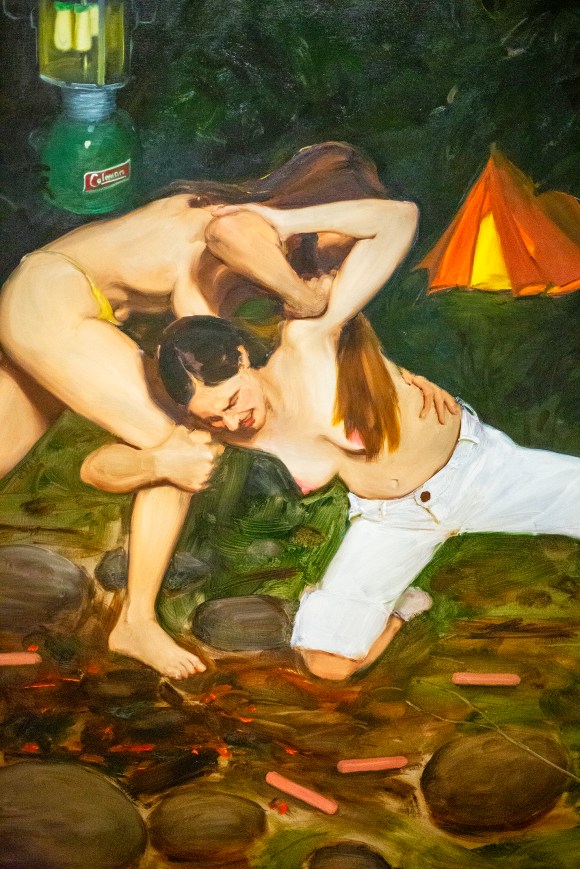
Jenna Gribbon, Weenie Roast Wrestlers, 2019. Women Painting Women exhibit at the Fort Worth Modern Art Museum.
The “plan”
For the unforeseeable future, the plan is to write about the history of humor in art. But in order to contain this beast, I’m going to focus my research on the visual humor of the Western world, primarily visual arts from the Americas and Europe (for now).
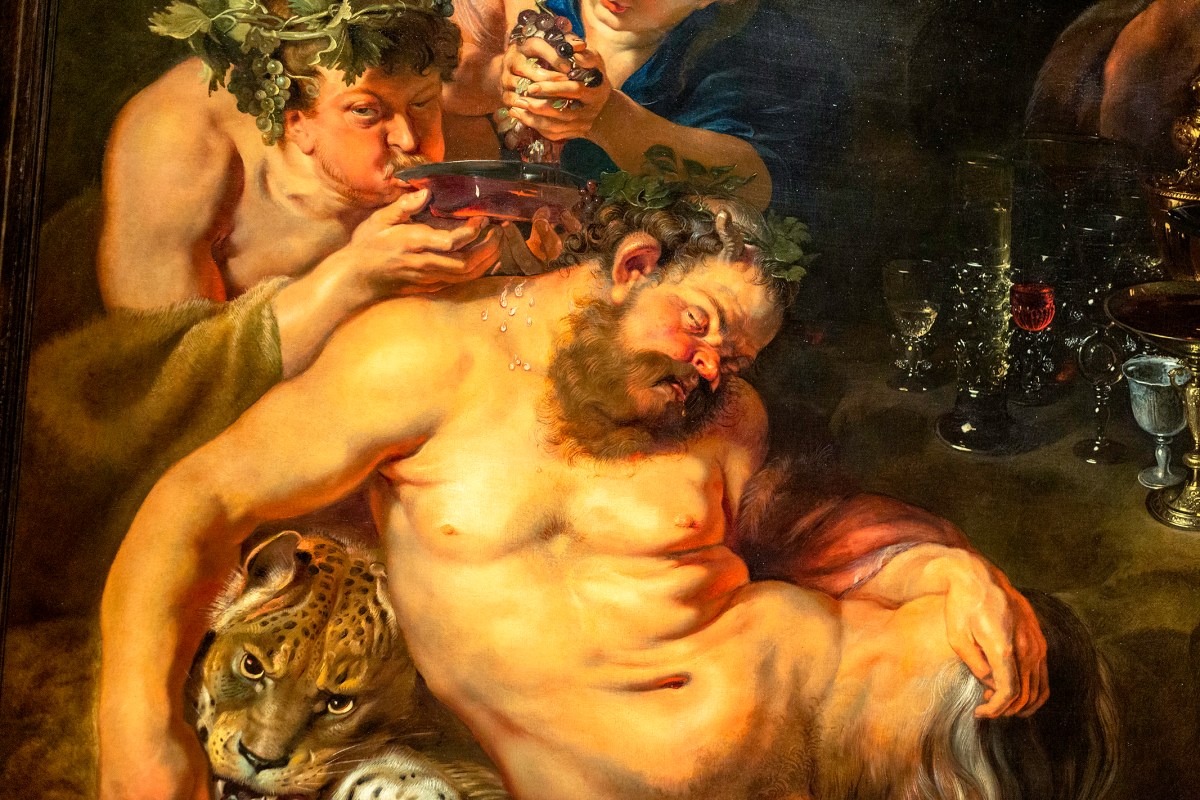
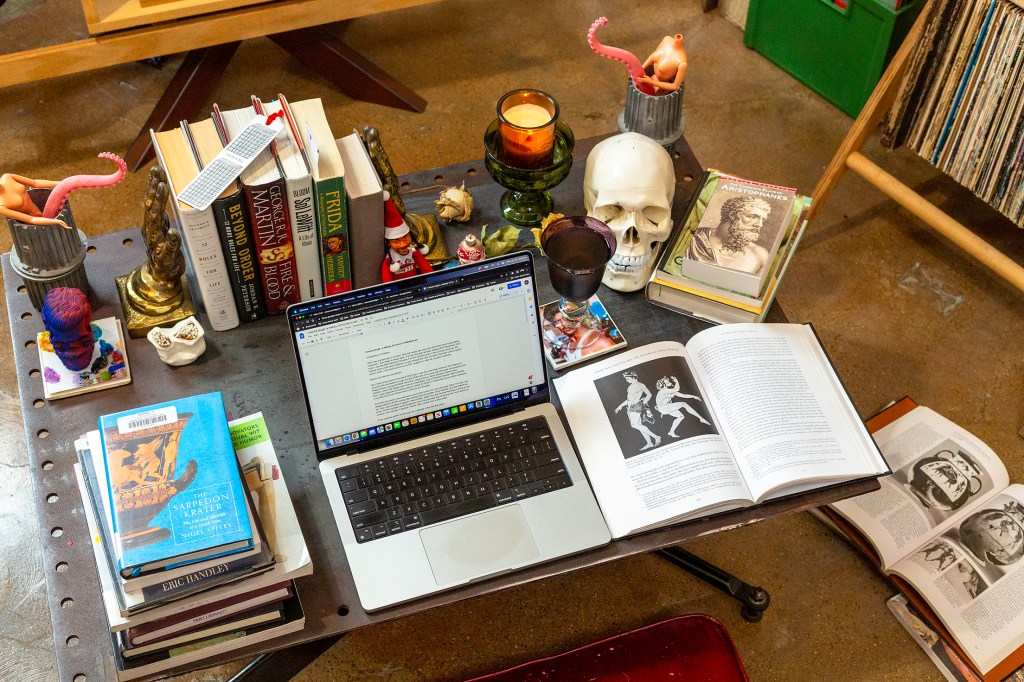
When you’re studying ancient Greek vase paintings, sometimes one must be under the influence of Bacchus to really get it. Let the research begin…
I’ll explore art throughout the centuries that has the potential to make you laugh, but most importantly—art that has the potential to make you think. From comic imagery on ancient Greek vase paintings to Pieter Bruegel’s satiric drawings on the follies of 16th-century Dutch culture to Marcel Duchamp’s literal toilet humor to Banksy’s subversive political messages on the streets around the world in recent memory.
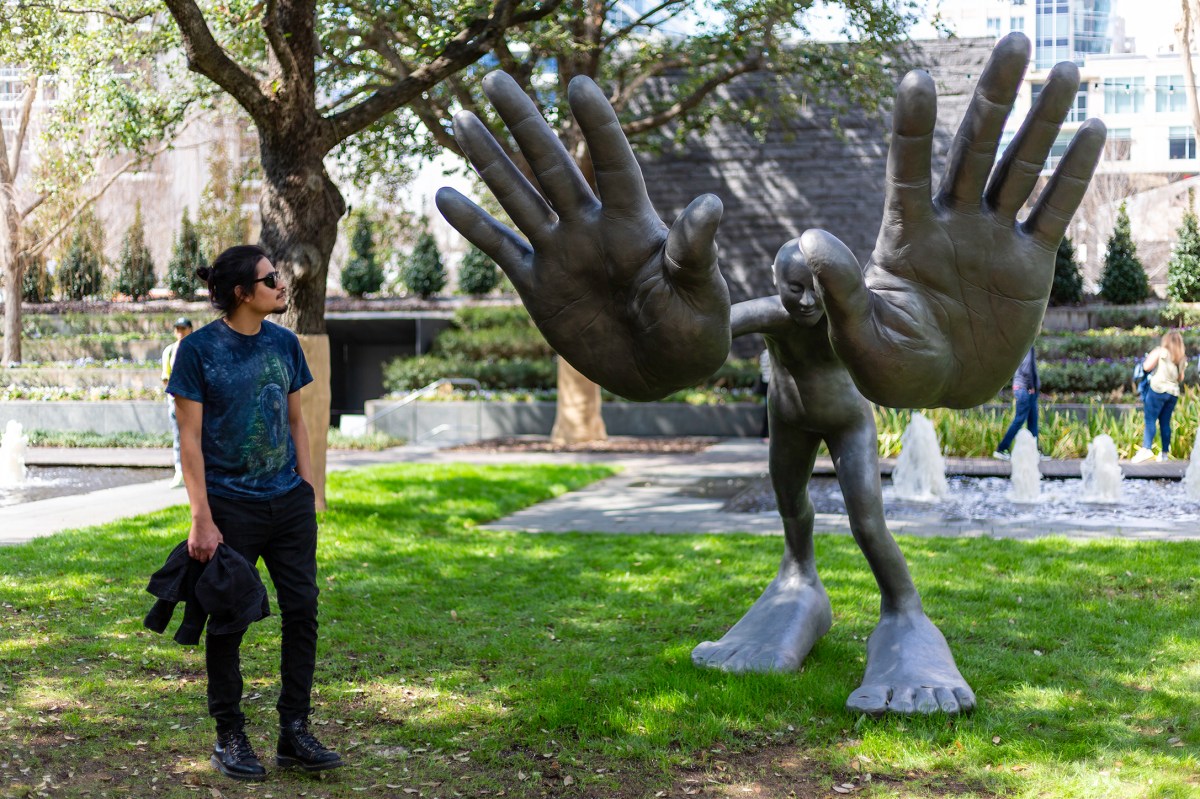
Nic Nicosia, bighands, 2010 (enlarged and cast in 2020). At the Nasher Sculpture Center.
When I say “humor”, I’m talking about whatever the hell makes you laugh. It can be through the use of irony, witticism, satire, dark humor, wordplay, or whatever other type of humor the artist feels is necessary to get their point across, whatever that point may be.
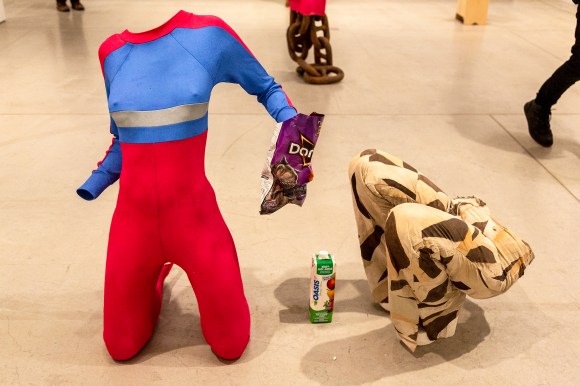
Valérie Blass, Le mime, le modèle et le dupe, 2019. At the Art Gallery of Ontario (AGO).
I haven’t exactly “planned” how often I’ll crank these suckers out (and by “suckers”, I mean thoroughly researched, high-quality art historical writings with a twist), as the history of humor for all Western art is actually quite a long stretch of time.
This writing project could take me years for all I know, and that’s completely fine. I’ve got time. I’m looking to publish a couple posts of my research on the history of humor in art this year, starting with the ancient world and moving forward as I see fit. You’ll just have to stay tuned, dear reader(s). I’m so sure you’re sitting on the edge of your seat in anticipation (and that’s what we call sarcasm).
I might write other art history-related writings in between, but for now—I wanna laugh.
Usually how I enter art museums. Also, will Christina P be my friend?
She might have been a big ol’ commie, but Frida Kahlo produced some of the most beautifully intimate and torturous self-portraits the world has ever seen—and that will always move me nonetheless. However, she wasn’t the only artist enthralled by communism at the start of what we now call the Mexican Modernism movement.
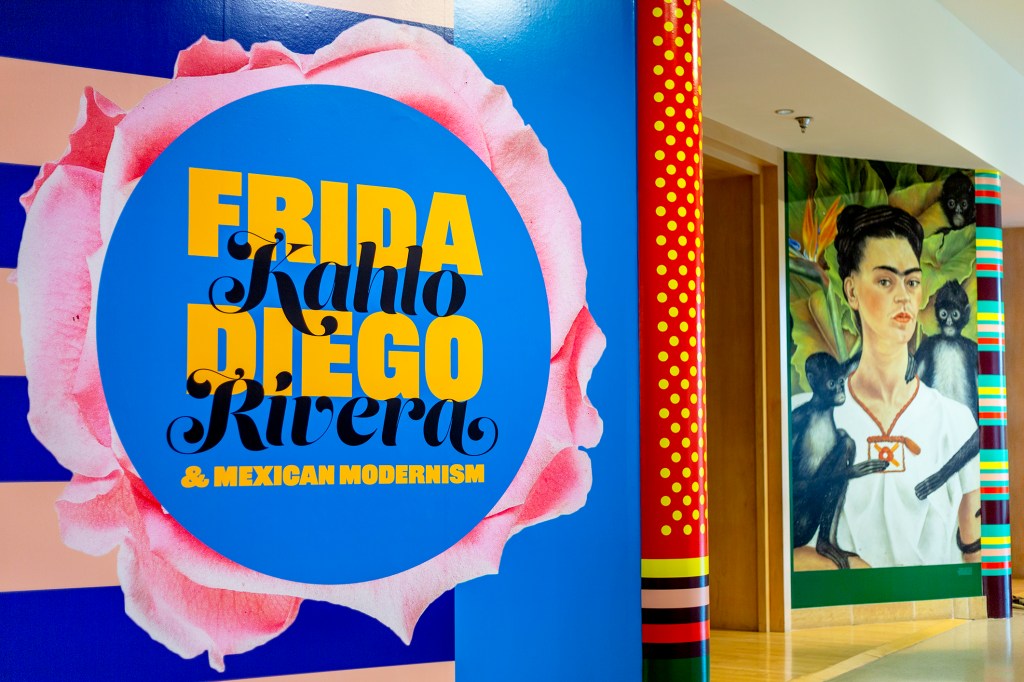
Frida Kahlo, Diego Rivera, and Mexican Modernism at the Philbrook Museum of Art, 2022.
I recently saw Frida Kahlo, Diego Rivera, and Mexican Modernism at the Philbrook Museum of Art in Tulsa featuring renowned Mexican artworks from the private collections of Jacques and Natasha Gelman. The exhibit not only explored Frida and Diego Rivera’s tempestuous marriage but also how modern artists in post-revolution Mexico sought to rebuild a national identity and celebrate the history of the land itself. As children of the revolutionary decade, it’s no surprise that politics—particularly Marxism—deeply influenced the work of Frida Kahlo and many of her leftist contemporaries during this great renaissance. And it got me thinking, of course…
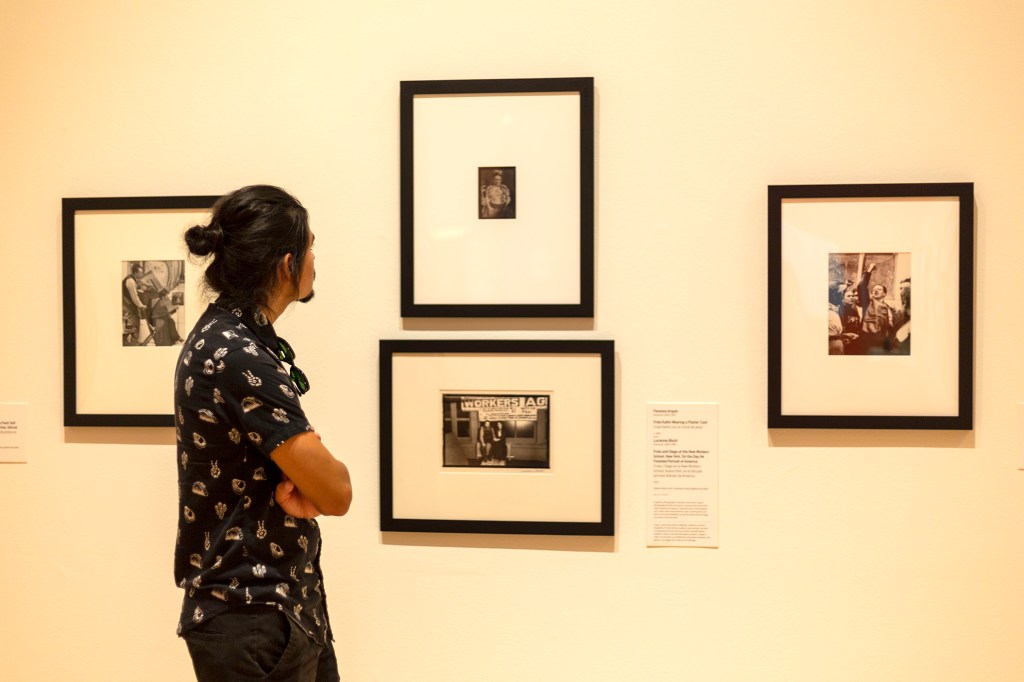
Jose learning about the commies and their ways, Frida Kahlo, Diego Rivera, and Mexican Modernism at the Philbrook Museum of Art, 2022.
Now, as a semi-capitalist pig myself, I don’t necessarily blame people back then for being swayed by communism. I’m sure the thought of a classless and egalitarian society where workers weren’t exploited by their elitist overlords sounded great after more than three decades under the dictatorship of Porfirio Díaz—which ultimately led to the Mexican Revolution of 1910.
But as we’ve seen with socialist and communist countries in recent memory, some kinks definitely need to be worked out. Who am I to judge though? I was so woke in my youth that I had not one, but two copies of The Communist Manifesto.
Yep, still have them.
Did I read either copy as a young radical Lefty? Of course not! There’s got to be a joke there somewhere—reader’s choice.
After the revolution
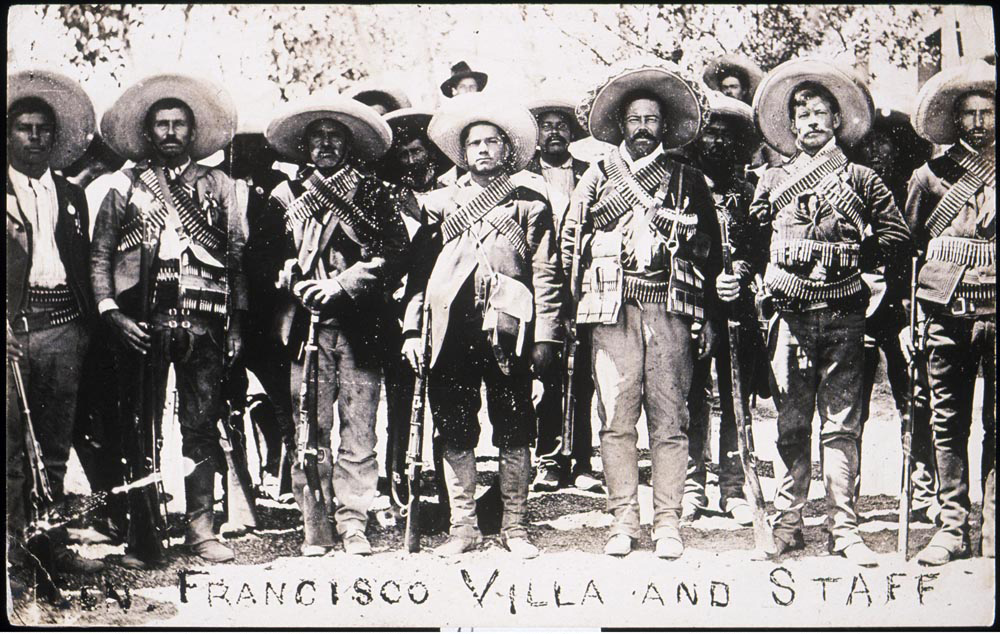
Francisco [Pancho] Villa and Staff, 1911, Unknown, via the Getty Open Content Program.
Regardless, the Mexican Revolution inspired noble efforts toward land reform and social equality, particularly access to economic and educational opportunities for all citizens. As the Constitution of Mexico was drafted in 1917—officially ending the revolution—the Russian Revolution began that same year, as did the formation of the Mexican Communist Party. By the early 1920s, Marxism-Leninism of the Soviet Union served as the best alternative to capitalism and imperialism among many revolutionary thinkers across Mexico.
At the same time, the new Mexican government (based on a democratic system) aspired to unify the politically divided nation. For many, the revolution delivered Mexico back to its people who fiercely rejected the “elitist values” associated with bourgeois European influences that long reigned under the dictatorial Díaz regime.
The time had come to celebrate Mexico’s history and cultural heritage by rediscovering its roots, customs, and traditions. Emphasis on the working class, Indigenous populations, and the ancient traditions of the Old World was key to Mexico’s new leadership that looked to the arts to help instill this new sense of national pride.
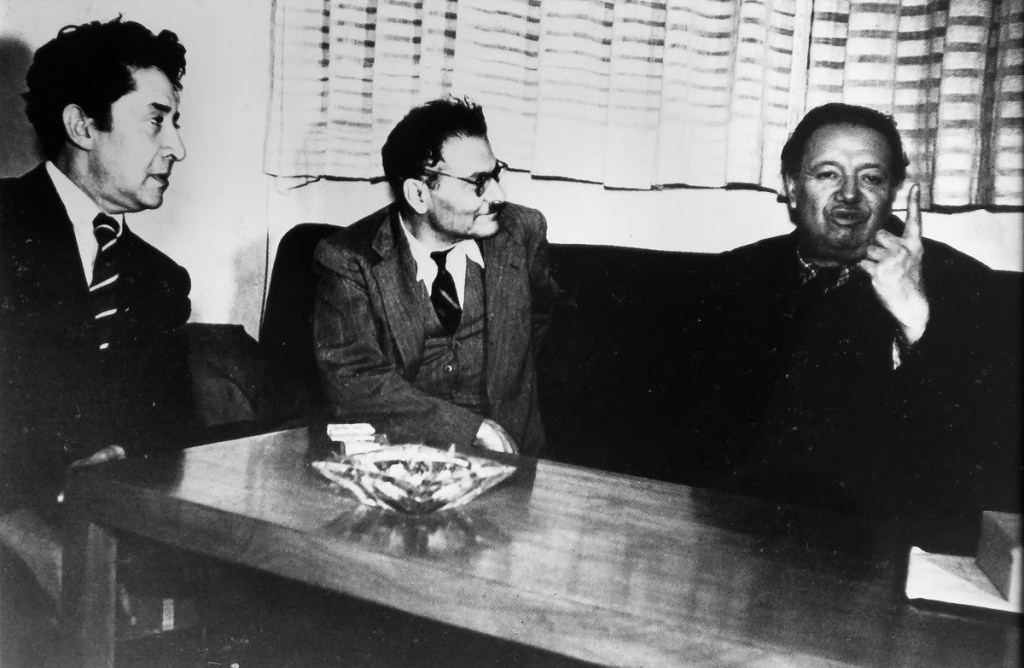
David Alfaro Siqueiros, José Clemente Orozco, and Diego Rivera—los tres grande in 1947 by Hermanos Mayo, via Museo Casa Estudio Diego Rivera y Frida Kahlo.
Under President Alvaro Obregón (1920-24), a new public art program was formed to commission artists to paint the story of Mexico on the walls of churches, schools, and other civic buildings. In 1921, Minister of Public Education José Vasconcelos (who participated in the revolt against Diaz) led the charge on this latest initiative and contracted the talents of José Clemente Orozco, David Alfaro Siqueiros, and Diego Rivera, or los tres grande as they would later be known, to paint these monumental public murals to reach the widest audience possible.
Frida Kahlo, the start of something
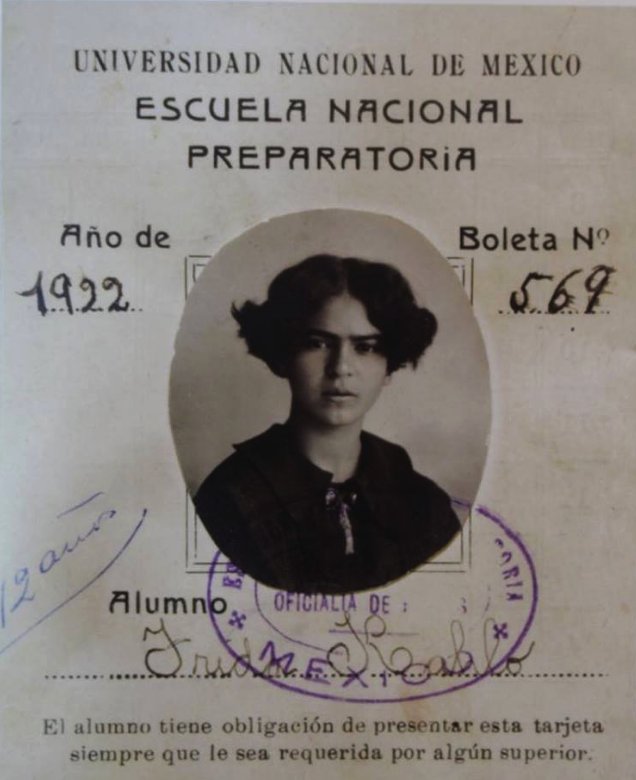
Frida Kahlo as a student at the Escuela Nacional Preparatoria, via Museo Frida Kahlo.
Vasconcelos believed art could inspire social change. And this was the exact idealistic post-revolutionary world a then 15-year-old Frida entered when she enrolled at the prestigious Escuela Nacional Preparatoria in Mexico City as one of 35 females in 1922—the same year the Soviet Union formed.
But political views even among students reflected the divisiveness seen on the national political stage. While radical students read Karl Marx and rejected religion, conservative students despised revolutionary reforms and fervently upheld Catholicism.
The same year Frida started school, a then 36-year-old Rivera began painting the Creation in the Preparatoria’s amphitheater—his first government-commissioned mural. But the promise of a new artistic hope didn’t last long as these same conservative students eventually vandalized the Preparatoria’s new murals the day Vasconcelos resigned as minister of education in 1924.
While her education encouraged her political young mind, Frida’s tragic bus accident on September 17, 1925, transformed her into the artist we know today. She was left with multiple broken bones throughout her body, along with serious internal injuries as a steel handrail tore through her abdomen. During her recovery at home, as she lay “bored as hell in bed” in a full-body plaster cast, her parents set up a lap easel for her and mounted a mirror above her bed’s canopy so she could begin painting herself. And so her rebirth as an artist began.
Her political views also intensified during this time. In 1927, Frida became an active member of the Young Communist League—attending workers’ rallies and giving speeches herself. The following year she joined the Mexican Communist Party where she reconnected with the larger-than-life Rivera.
Though “officially” they met the following year when she asked for a critique of some of her work, including her first Self-Portrait, while he painted his grand Mexicanidad on the walls of the Secretaría de Educación Pública.
Diego Rivera, The Arsenal, 1928, Secretaría de Educación Pública, via diegorivera.com.
Either way, there was no denying they were a match made in Communist non-heaven. Rivera soon added The Arsenal to his all-encompassing mural with Frida standing militantly in red as she distributes weapons to workers—hammer-and-sickle flag in the background. Rivera also flanked his Communist queen with the likes of other zealous comrades such as artists Tina Modotti and Siqueiros. The Mexican power couple married a year later on August 21, 1929.
But Mexico didn’t quite turn into the Marxist utopia revolutionary leaders thought it would. Even Rivera soon found himself in a predicament as those on the right viewed him as an “agent of the revolution” while many Stalinists saw the muralist as a “painter for millionaires” and attacked his friendships with government officials. The final straw came after he accepted another government commission to paint a public mural, this time at the Palacio Nacional, that resulted in Rivera’s expulsion from the Mexican Communist Party. Frida quite soon after in solidarity.
And if this didn’t piss the commies off enough, Rivera’s ironic acceptance of multiple commissions across the United States—including his highly controversial Man at the Crossroads mural—probably really set them off.
But the muralist didn’t mind taking commissions from the Mexican government or American capitalists. After all, didn’t Lenin counsel fellow comrades to influence the system from within? As Rivera saw it, this was his chance to create public revolutionary art (or communist propaganda) to glorify the cause in the land of capitalism.
And Frida was by his side the whole way, no matter how much she despised Gringolandia.
Frida goes to America
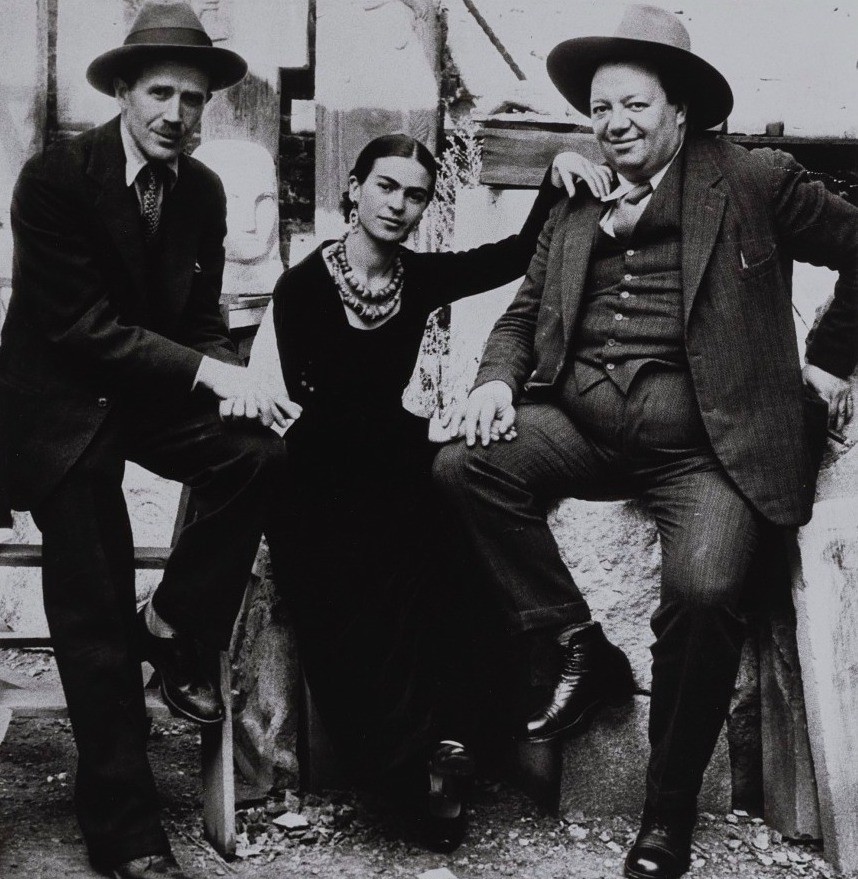
Sculptor Ralph Stackpole with Frida and Diego in San Francisco, via Archives of American Art, Smithsonian Institution.
Frida and Diego ventured to the United States at the end of 1930, residing in San Francisco initially before heading over to Detroit and New York City for his work. She kept up with painting as well.
Where Rivera often painted large-scale public murals to visually communicate the history, politics, and plight of the class struggle, Frida painted smaller, intimate paintings of what was immediately around her. Subjects consisted of friends, family, still lifes, and most importantly—herself. But it’s during their three-year stay in America that her views on the world really began to unfold on canvas.
Personal trauma aside, Frida grew quite critical of the U.S. during this period, writing to her mother: “Witnessing the horrible poverty here and the millions of people who have no work, food, or home, who are cold and have no hope in this country of scumbag millionaires, who greedily grab everything, has profoundly shocked [us].”
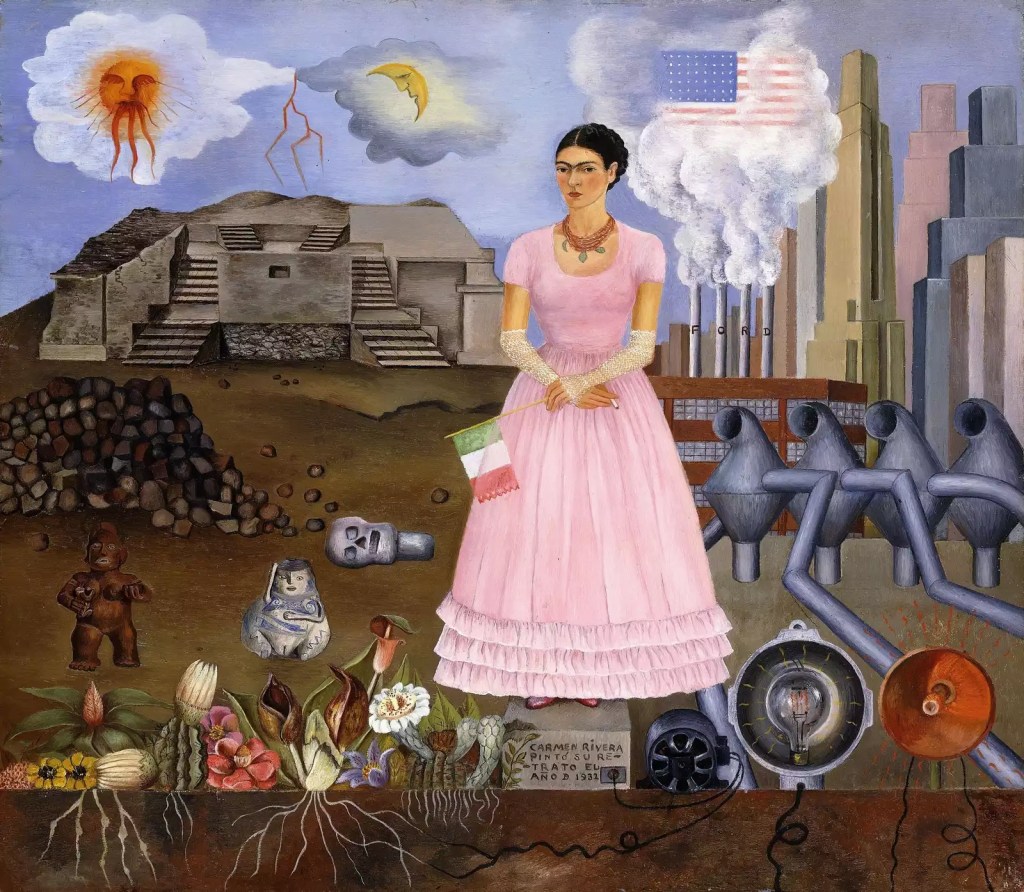
Frida Kahlo, Self-Portrait on the Borderline Between Mexico and the United States, 1932, via Banco de México Diego Rivera Frida Kahlo Museums Trust, Mexico, D.F. / Artists Rights Society (ARS), New York.
Frida soon painted Self Portrait on the Borderline Between Mexico and the United States (1932), which represents her longing for Mexico. And judging by her resting bitch face, she’s certainly not in the mood as she dons an uncharacteristically fancy pink dress and lace gloves. But in an act of defiance, she holds a lit cigarette in one hand and a Mexican flag in the other—showing us where her loyalties lie.
There’s a clear distinction between both countries. On the left, Frida showcases the indigenous culture of ancient Mexico with an Aztec temple, fertility sculptures, and flourishing native plants in the foreground. In direct contrast on the right side, an American flag nearly becomes lost in a cloud of industrial factory smoke, while skyscrapers and inventions of the modern world command the scene. Instead of plants, machines sprout from the earth with electrical cords as roots, though one sly cord creeps across the border, symbolizing America’s seemingly exploitative nature.
Diego, on the other hand, really dug America or perhaps just really enjoyed his stardom in the land of the free. Either way, Mexico began to represent the past in his mind as he believed a worldwide revolution would only happen in an industrialized nation. But Frida didn’t buy this notion, reflected in her next political commentary My Dress Hangs There (1933) she began painting while residing in Manhattan—the capital of capitalism as far as she was concerned. Though I won’t argue with her there.
Frida Kahlo, My Dress Hangs There, 1933, via fridakahlo.org.
The scene is certainly chaotic, to say the least. Frida pokes fun at Americans’ preoccupation with indoor plumbing (not as common in Mexico at the time) and competitive sports as she depicts a giant toilet and golden trophy propped up on pedestals like valuable works of art. But her empty Tehuana dress serves as the focal point, expressing that while her dress may hang in the city, Frida herself is far removed from the superficial nature of American capitalism.
Behind her dress, big business and religion dominate the middle ground with a red ribbon connecting the Trinity Church to Federal Hall on Wall Street while crushing the collaged masses of the Depression years at the bottom of the painting. Among crowded skyscrapers, a Mae West billboard stands out, representing vanity and celebrity obsession as buildings burn below. A garbage pail also overflows on the right with disregarded commodities and some questionable human organs.
Frida was done with Gringolandia. After many heated arguments, Frida and Diego returned to Mexico at the end of 1933 once he completed his murals at the New Workers’ School in NYC.
Returning to the motherland
Life became no easier for Frida once the couple moved back to Mexico City. A sulky Diego blamed her for their return, and eventually had an affair with her younger sister, Cristina. As gut-wrenching as this was for Frida, she got hers in due time by having an affair with Rivera’s dear friend and Mr. October Revolution himself—Leon Trotsky.
Leon Trotsky and his wife arrive in Tampico, Mexico, surrounded by police and Frida Kahlo, via Keystone/Getty Images.
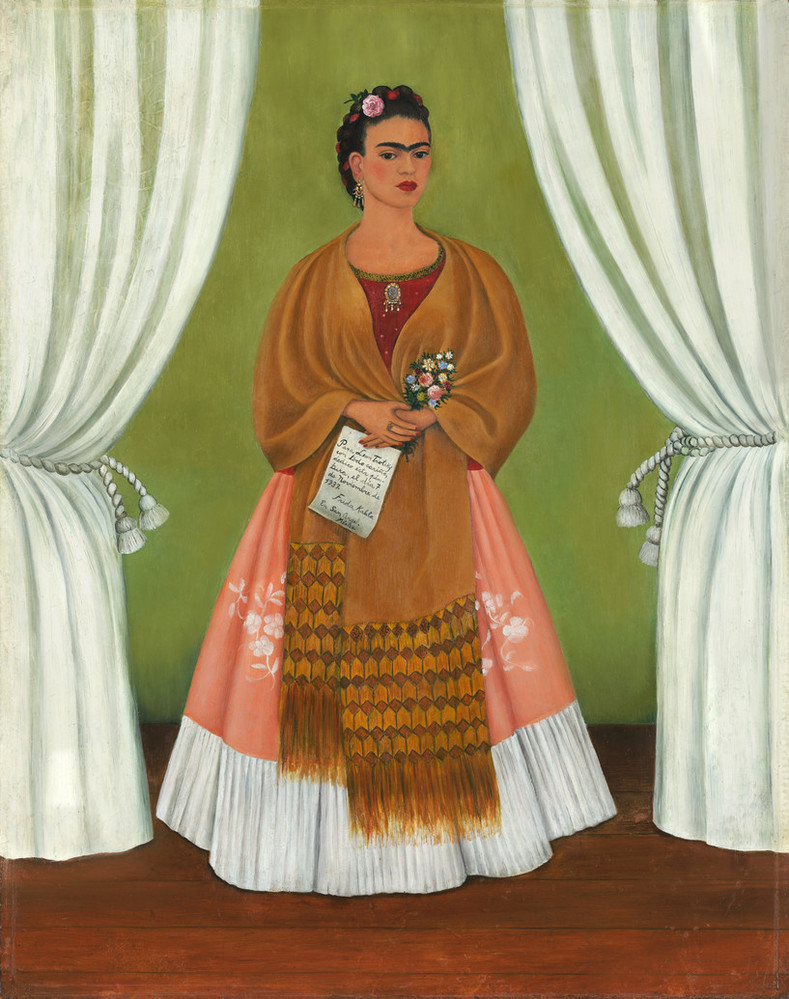
After his banishment from Joseph Stalin’s Soviet Union, Trotsky was granted political asylum in Mexico thanks to a very persuasive Rivera, who was also previously expelled from the pro-Stalinist party. The Russian revolutionary hero arrived in Mexico City in January 1937 with his wife Natalia Sedova. Months after their affair ended, Frida and Trotsky remained close as she gifted him her Self-Portrait Dedicated to Leon Trotsky on his birthday and the twentieth anniversary of the Russian Revolution on November 7, 1937.
Frida Kahlo, Self-Portrait Dedicated to Leon Trotsky, 1937, via Banco de México Diego Rivera Frida Kahlo Museums Trust, Mexico, D.F. / Artists Rights Society (ARS), New York.
Self-assured and oh-so seductive, Frida teases her ex-lover with her feminine beauty as she presents herself between two curtains clad in an elegant dress with plump red lips and flowers woven into her hair. She holds a flower bouquet and a document that reads: “To Leon Trotsky, with all my love, I dedicate this painting on 7th November 1937. Frida Kahlo in Saint Angel, Mexico.”
Due to personal and political turmoil, Rivera and Trotsky’s friendship eventually dissolved. The Russian leader left Frida’s painting behind when he moved out of Casa Azul at the request of his wife (duh). On August 21, 1940, Trotsky died after he took a pickaxe to the skull the day before. Diego and Frida were both suspects in Trotsky’s assassination though only the latter was thrown in jail for a couple of days.
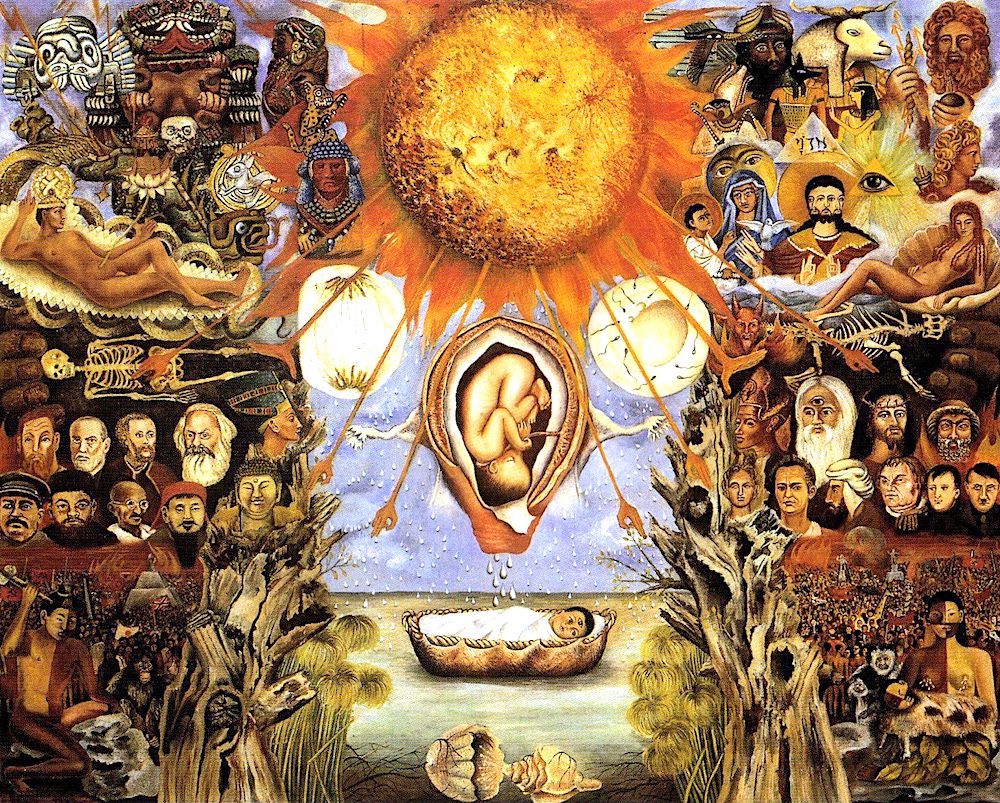
In addition to politics, all time and space were apparently on the mind of Frida Kahlo once 1945 rolled around. She produced Moses based on Sigmund Freud’s Moses and Monotheism (1939), finishing the painting only three months after reading the book.
The central focus depicts the birth of Moses—representative of the birth of all heroes. The infantile hero is surrounded by female reproductive organs with a massive radiating sun above that the artist described as “the center of all religions, as First GOD and as creator and reproducer of LIFE.”
Frida Kahlo, Moses, 1945, via fridakahlo.org.
On both sides of baby Moses, we see various historical heroes or the “big wigs” of history as Frida referred to them—from Budda and Jesus Christ to Karl Marx and Adolf Hitler (though she saw him as the “lost child” of the group).
Fun fact: she dropped the “e” from the original German spelling of her name—Frieda—due to the rise of Nazism.
Moving on, below these “heroes” are the masses engaged in warfare that prop up the winners of history while the gods across all religions and mythologies dominate the sky above. Dividing the scene below are two ancient tree trunks, which Frida often used in her works as a symbol for the cycle of life and death.
“Always revolutionary, never dead, never useless”
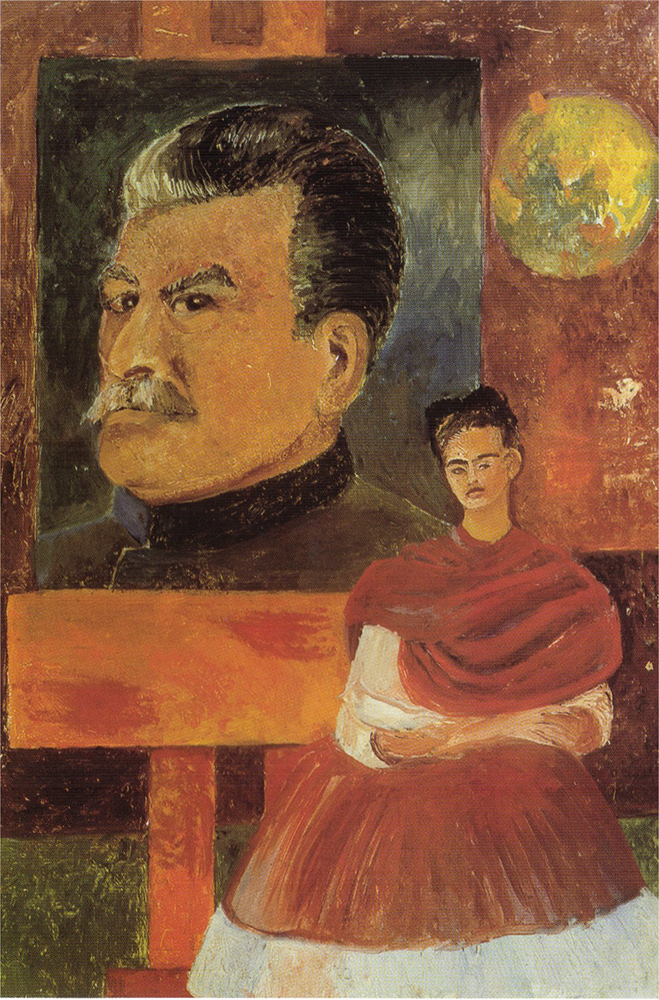
Until her death, Frida was wholeheartedly devoted to her political faith. Before leaving this world behind in 1954, the Communist queen painted two more political works that same year, including Self-Portrait with Stalin which she began working on after his death in March 1953.
Frida Kahlo, Self-Portrait with Stalin, 1954, via fridakahlo.org.
Once a Trotsky sympathizer, Frida’s loyalties now lied with Stalin as she sits in front of a large portrait of the indisputable Soviet leader elevated on an easel as a globe hovers next to it. But due to her declining health and various medications, the artist was unable to paint with the same precision we’ve seen in her previous paintings.
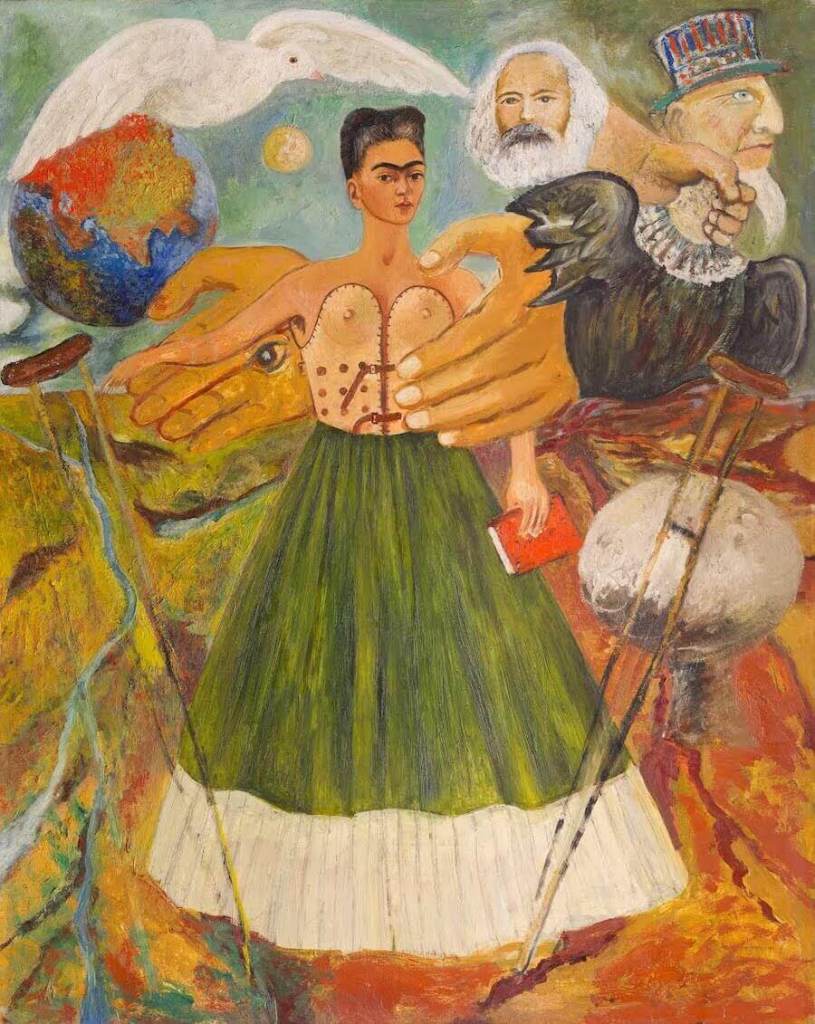
In her last political work, Marxism Will Give Health to the Sick, Frida stands confidently in a leather orthopedic corset with a red book in hand, perhaps the Communist Manifesto. To the right, we see Karl Marx’s floating head in the sky with a hand coming out the side—wringing the neck of an American eagle with the head of Uncle Sam (the original title was Peace on Earth so the Marxist Science may Save the Sick and Those Oppressed by Criminal Yankee Capitalism,after all) while the opposing side shows a peace dove flying over the globe.
Frida Kahlo, Marxism Will Give Health to the Sick, 1954, via fridakahlo.org.
Two oversized hands support the artist that appears to come from the god-like white-bearded Marx in the sky—allowing Frida to let go of her crutches as she accepts her fate. And it reminded me of something she once said: “I am nothing but a “small damned” part of a revolutionary movement. Always revolutionary, never dead, never useless.” Frida Kahlo died on July 13, 1954. Diego draped her coffin with a hammer and sickle flag, making sure his devoted wife was “always revolutionary”—even in death.
Ironically, as we now see, Frida Kahlo became one of the most commercialized artists of all time with her image plastered over all types of commodities—from t-shirts, mugs, and purses to an actual damn Barbie doll. And she probably would have hated it all. Or she might have loved it, who am I to say?
Even though she loathed America, the country I will always call home (despite its imperfections), Frida’s life, work, and commitment to artistic expression will always hold a special place in my heart. Just because you may disagree with someone politically, doesn’t mean you can’t empathize with or learn something of value from them. This has taken me nearly my whole life to learn. We’re all human, we all suffer. Of course, Frida lived in a completely different time and place. Who are we to judge with our contemporary eyes?
As far as I’m concerned—Frida Kahlo is one of the GOATs.
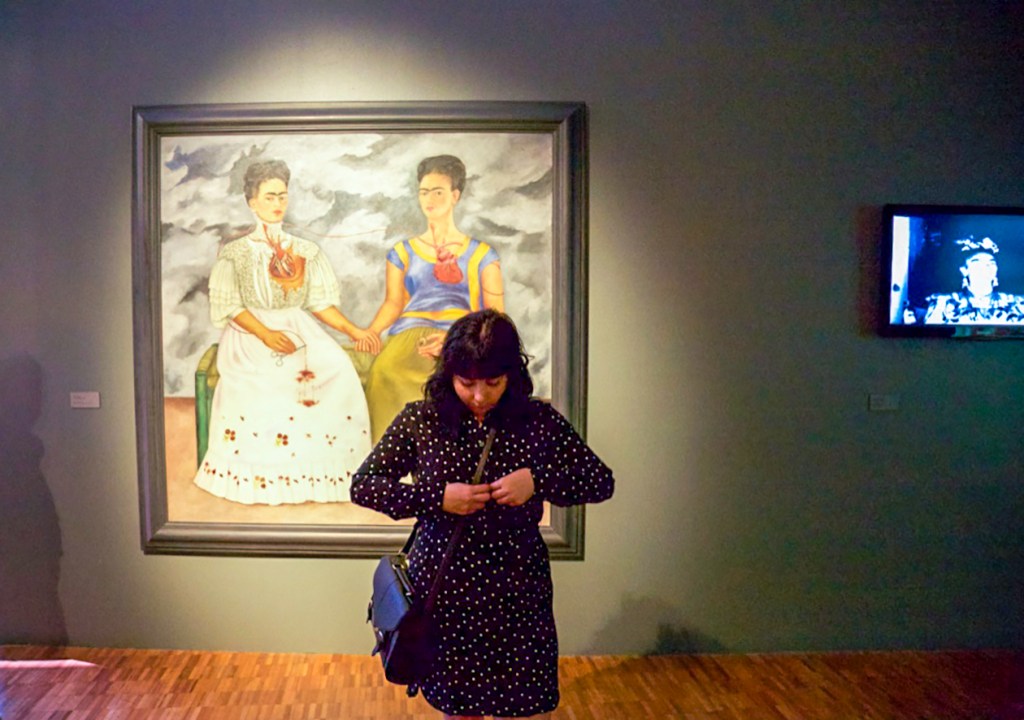
That time my dress opened in front of The Two Fridas, Museo de Arte Moderno, Mexico City, December 2014.
At Fair Park in Dallas, the broads stand guard day and night. And they’re probably judging you—just a little bit.
It is in our nature after all.
I’ve lived in Dallas my whole life (minus two years in Madison for grad school) but never really appreciated this historic landmark until recently. Sure, I’ve attended the State Fair of Texas several times since I was a kid but never once did I closely examine the amazing Art Deco style art and architecture that surrounded me. Instead, I usually just walked around stuffing my stupid face with deadly fried treats while guzzling down mediocre beer like the true patriot that I am.
Well, a few months ago, my husband and I took Frida (the dog, not the artist) on our Sunday morning walk around Fair Park. And as we strolled around the Esplanade, I suddenly realized that a majority of the sculptures in the vicinity are of the female form. How did I miss this detail before?
Obviously, I’m a little slow sometimes. But I do eventually get there.
And since I’ve gotten “there”, I had to learn more! From the Founders Statue to Contralto, let’s get to know these proud women that run Fair Park. But first, we’ll take a quick look at how these monumental sculptures came to be with the Texanic celebration that started it all: the Texas Centennial Exposition.
Esplanade of State at night, 1936.
Designing the Texas Centennial Exposition
As the 100th anniversary of Texas’s independence from Mexico was fast approaching in 1934, state leaders knew the moment had to be met with a new symbol of hope in the middle of Depression-era gloom. And here was the perfect opportunity to not only boost the economy, but also encourage statewide growth, development, and tourism by shining a light on Texas history.
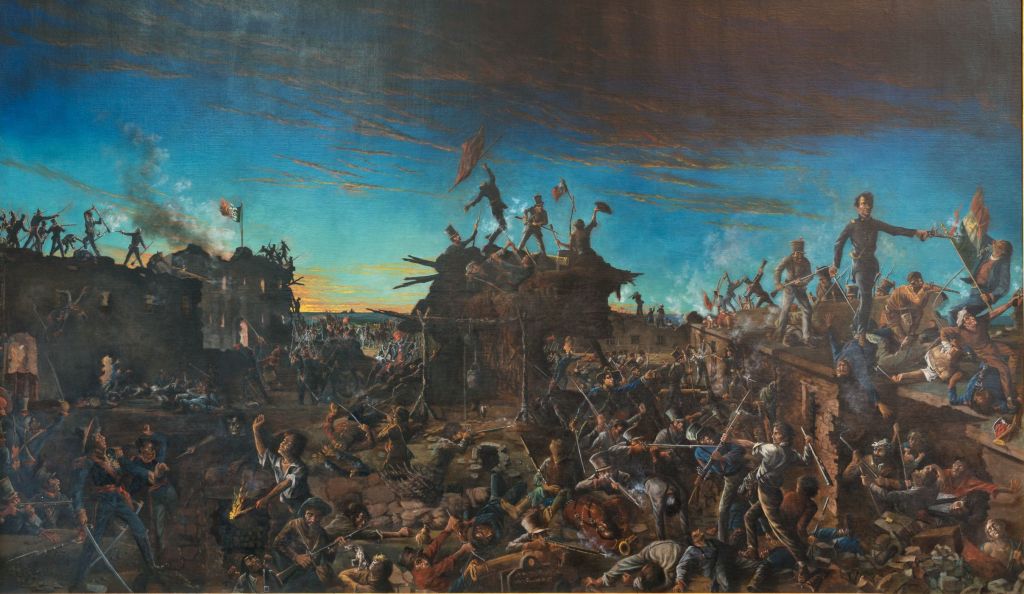
Henry Arthur McArdle, Dawn at the Alamo, 1905.
The Texas Legislature created the Texas Centennial Commission that managed celebrations across the Lone Star State and called for city proposals to host the big central Texas Centennial Exposition. After Austin and Fort Worth dropped out of the running, the three largest urban centers in the state—San Antonio, Houston, and Dallas—were the top contenders.
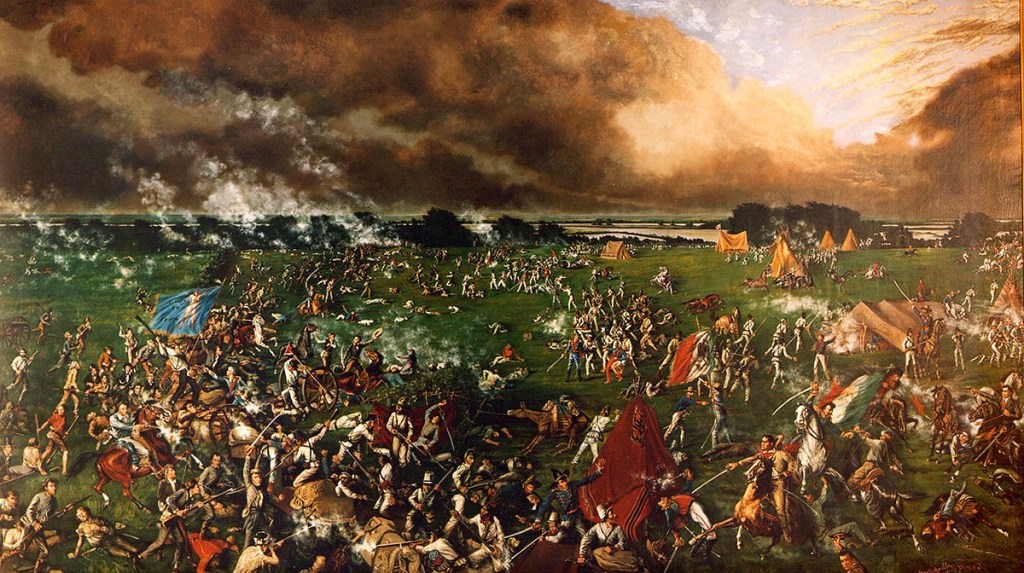
Henry Arthur McArdle, The Battle of San Jacinto, 1895.
But we know how this story ends. Sure, Dallas didn’t even exist during the Texas Revolution. And sure, San Antonio and Houston might have had glorious revolutionary connections on their side with historical landmarks like the Alamo and San Jacinto Battleground (close proximity anyway), respectively. But you know what we had that they didn’t? MONEY. Robert Lee Thorton, head of the Dallas Centennial Commission, pledged $7.8 million, and Dallas’s bid to host the Texas Centennial Exposition was officially accepted in September 1934.
Once all funding was finalized, exposition leaders finally set their focus on transforming Fair Park for the big Texas-sized event. Dozens of existing State Fair buildings were remodeled while 50 newly designed buildings were on the rise. All 183 acres were set to be landscaped and the installation of several miles of utility lines, sidewalks, and streets would soon seal the deal. And all for the low, low price of an estimated $25 million. That’s exactly what you want to hear in the middle of a Depression, isn’t it?
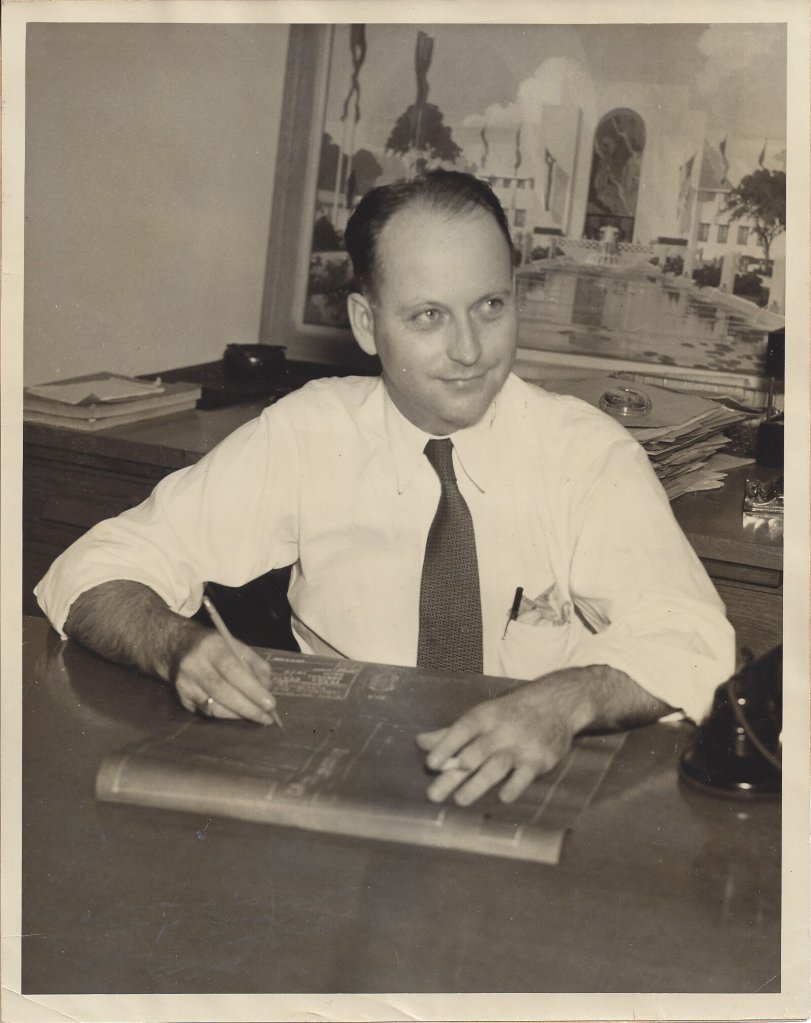
George Dahl—one of the architects responsible for designing Dallas.
Regardless, the man in charge of delivering the goods was none other than hometown hero George Dahl. He already made a name for himself designing the Neiman Marcus Building and Titche-Goettinger Company Building in downtown Dallas, along with multiple buildings at the University of Texas in Austin. But most importantly, Dahl knew what went into creating an exquisite exposition after attending several world’s fairs across the United States and Europe.
As the centennial architect and technical director, Dahl brought in a dream team of architects, artists, designers, and engineers to help bring his grand vision to life. Several members worked at the 1933 Century of Progress International Exposition in Chicago including artists Raoul Josset, Carlo Ciampaglia, Pierre Bourdelle, and Jose Martin, along with architect Donald Nelson who was brought on as Dahl’s chief designer. Nationally renowned architects Albert Kahn and William Lescaze were also recruited for specific projects, as well as Prix de Rome-winning sculptor Lawrence Tenney Stevens. And finally, architect Paul Phillippe Cret was hired to draw up the master plan for the Fair Park grounds as construction began in the summer of 1935.
Were the local artists of the Dallas Nine pissed off by all these damn out-of-towners dominating their art turf? Of course! But alas, that’s another tale for another day. Though these Texas regionalist artists, including Jerry Bywaters, did assist these higher profile artists.
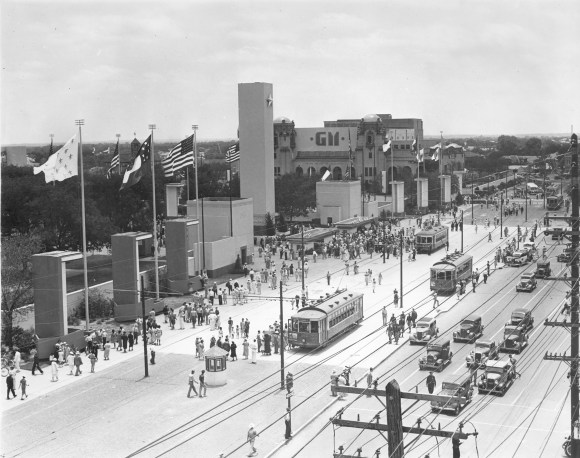
Texas Centennial Exposition, Parry Avenue entrance to the State Fair, 1936.
With its pristine landscape, colossal buildings, and bold sculptures, Fair Park soon completely transformed into something magical that the citizens of Dallas had never seen before. In fact, the exposition grounds became known as “Magic City.” Spanish Colonial style (a salute to the architectural heritage of Texas) with a dash of ancient Greek and Egyptian influences served as inspirations for Dahl. Yet, he also had a very stylized, modern approach with a neutral color scheme and simple, clean lines devoid of extravagant ornamentation that screams Art Deco.
The Texas Centennial Exposition opened on June 6, 1936, with the theme: “An Empire on Parade”. Over six million attendees, including President Franklin D. Roosevelt, visited Fair Park from across the nation in complete awe of the magnificent Parry Avenue entrance that lead to the exposition’s majestic exhibition halls, museums, and larger-than-life sculptures during its six-month run. And it’s at the Parry Avenue entrance that we’ll begin our walkthrough of the sculptured women that still watch over the Fair Park in Dallas today.
Founders Statue
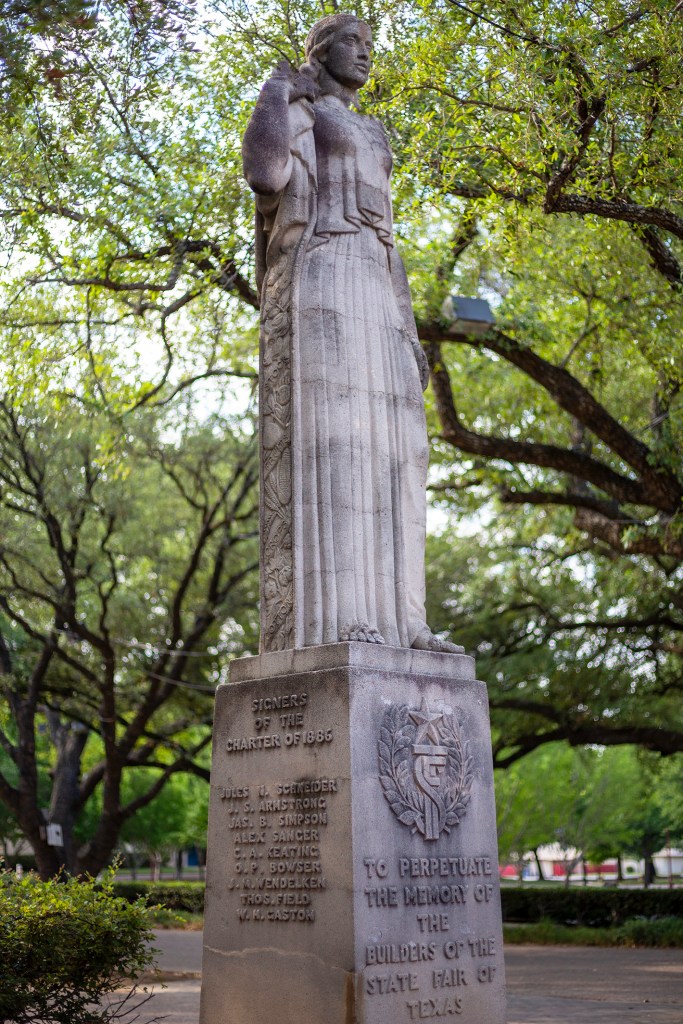
Walk through the Parry Avenue entrance and the first lovely young broad you’ll meet is the Founders Statue.
Okay, she wasn’t originally featured at the Texas Centennial Exposition but was designed by Raoul Josset, Donald Nelson, and Jose Martin, then sculpted by Martin alone in a similar style to the Art Deco sculptures throughout the Esplanade of State produced for the exposition. She confidently stands tall draped in a long flowing dress reminiscent of a powerful Greek goddess.
As a tribute to the founders of the State Fair of Texas, the Founders Statue was unveiled at a dedication ceremony held in honor of the State Fair’s 50th anniversary on October 8, 1938. The concrete sculpture also honored the Texas press that helped to promote the annual celebration. The actual 50th anniversary was in 1936 but the ceremony was postponed for two years due to the Texas Centennial Exposition and the Greater Texas & Pan-American Exposition in 1937.
And here’s a fun fact for you: there’s an iron crypt at the base of this sculpture. The time capsule included State Fair, Texas Press Association, and Dallas Morning News documents, along with 300 newspapers from October 8, 1938. The crypt was to be reopened 50 years later in 1988 but things didn’t exactly work out as planned. State Fair officials soon discovered a leak that developed sometime over the years, and all historical documents inside were destroyed. Needless to say, the official reopening ceremony was canceled.
Spirit of the Centennial
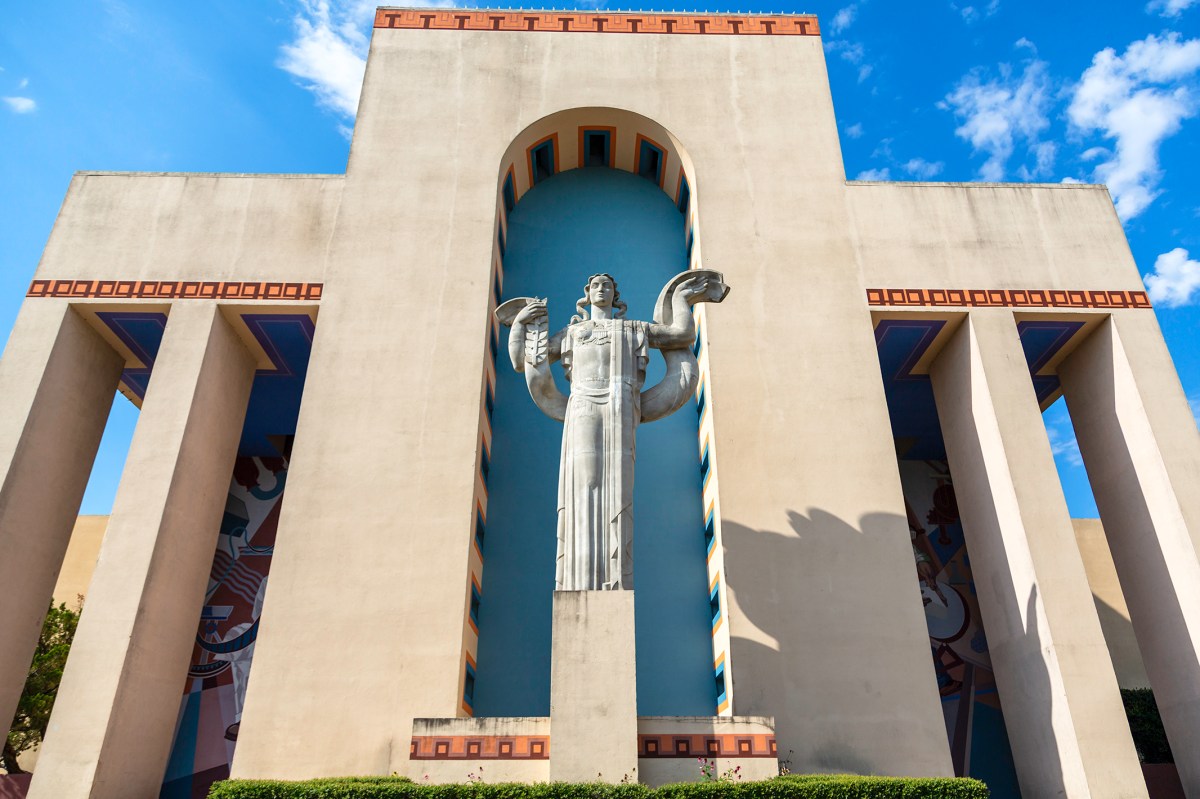
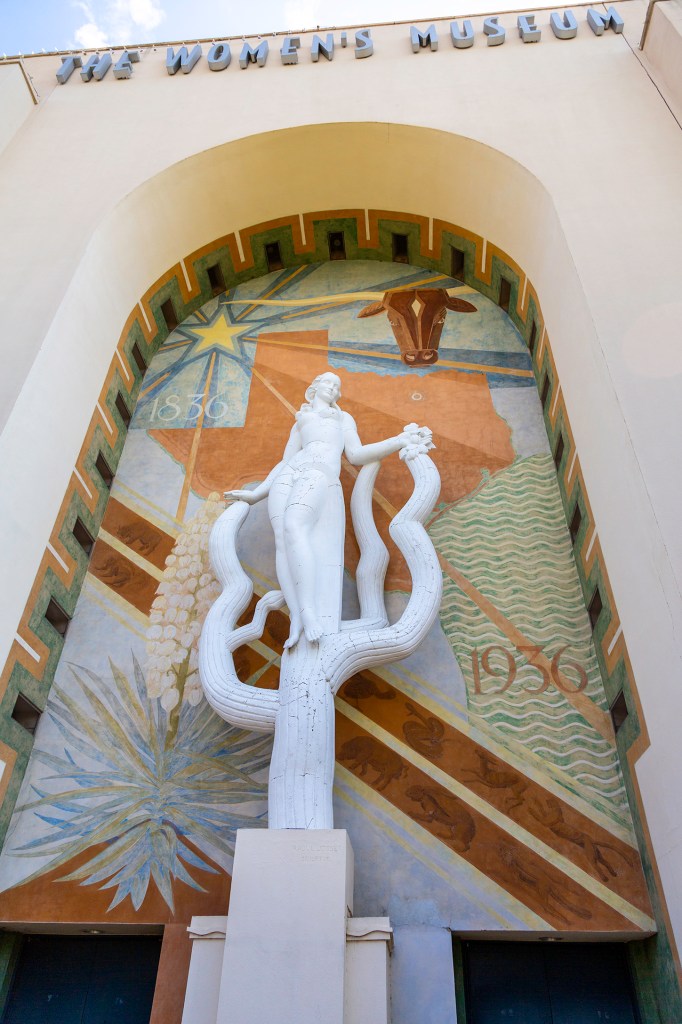
Next on your left, it’s hard not to notice the Spirit of the Centennial that’s at the center of The Women’s Museum. Though at the time of the exposition, this was the Administration Building for exposition staff until architect Wendy Evans Joseph converted it back in 2000.
Designed by Josset and sculpted by Martin, the Spirit often draws comparisons to The Birth of Venus (1486) by early Renaissance painter Sandro Botticelli. But the Texas goddess stands 20 feet tall on a saguaro cactus (that doesn’t actually grow in Texas—but it was all the same to the very French Josset) rather than a seashell. While the saguaro cactus might not be native to Texas, the mural by Carlo Ciampaglia behind the Spirit does depict Texas flora and fauna.
Georgia Carroll, a 16-year-old model from Blooming Grove, Texas, posed for the sculpture after Josset discovered her at a beauty contest. Though it only reflects Carroll from the neck up as she refused to pose nude for Josset because hello: she was underaged. Martin completed the Spirit in just ten days but raced against the clock and was still putting on the finishing touches when the gates opened for the Texas Centennial Exposition that morning.
SpainConfederacy
The Six Ladies of Texas
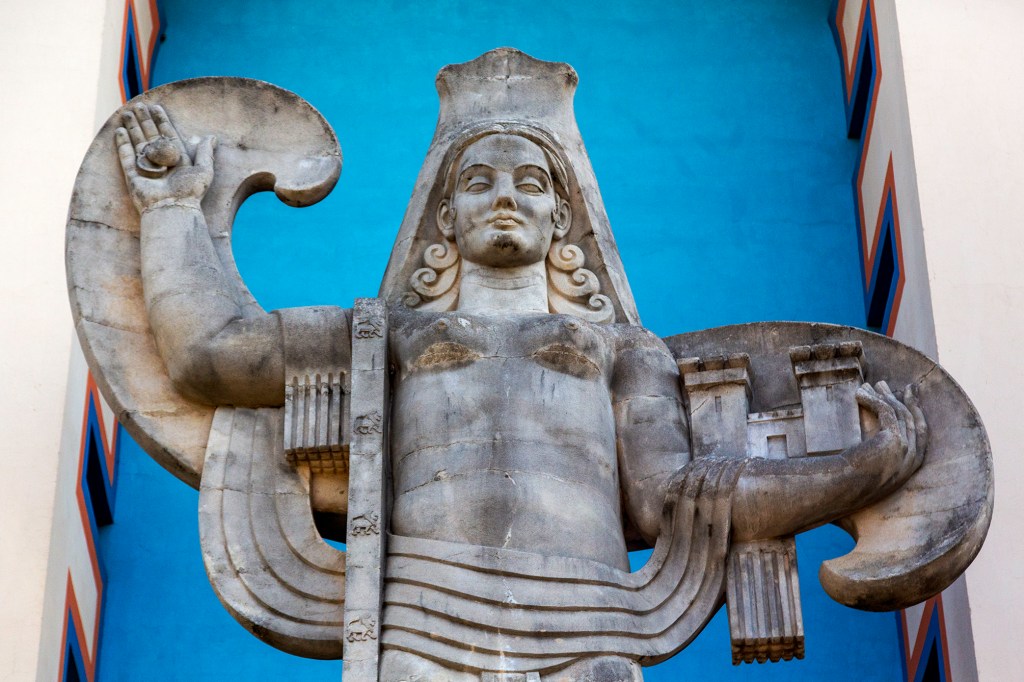
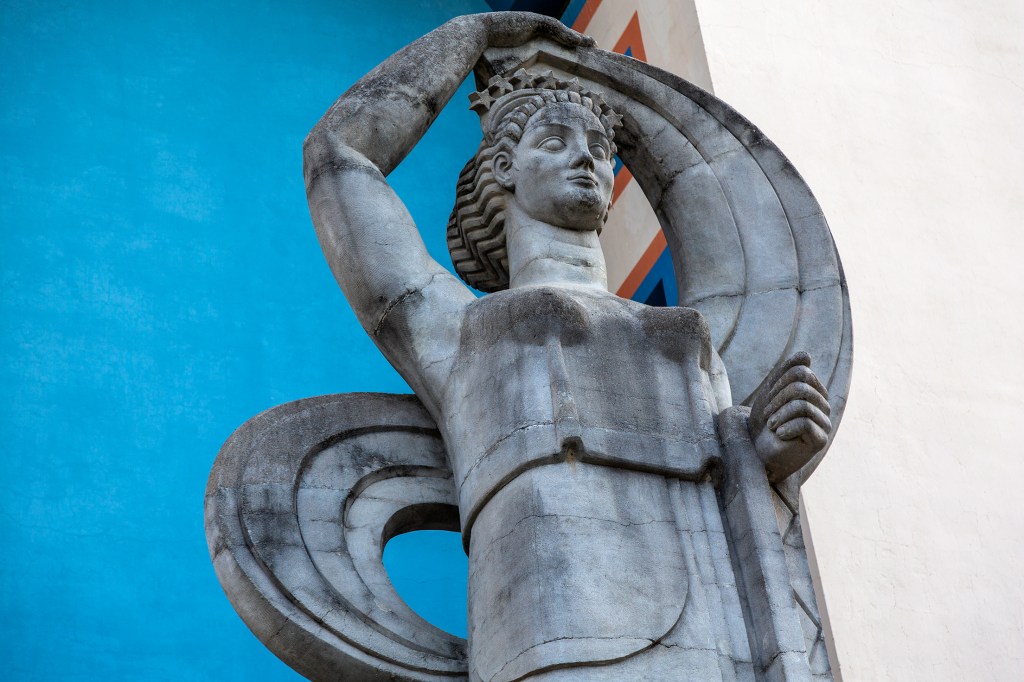
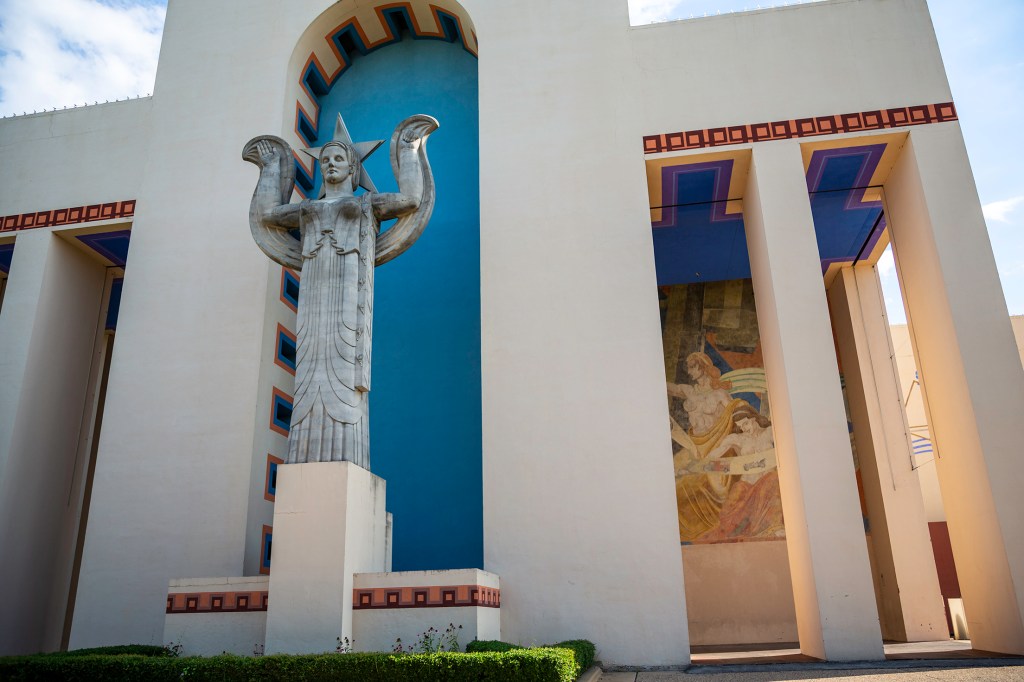
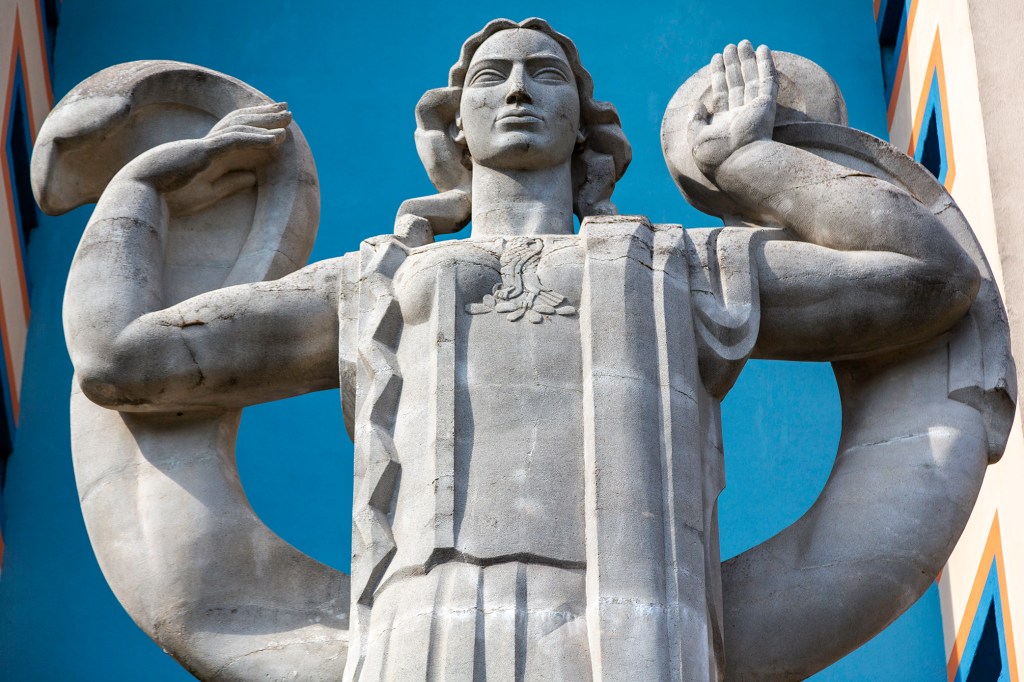
Continue making your way toward the Esplanade of State and you’ll find an alluring 700-foot reflecting pool in the center flanked by the Six Ladies of Texas along the façades of the Transportation and Varied Industries buildings. Each massive 20-foot cast-stone sculpture stands powerfully on 12-foot pedestals in their own niches, each representing the six flags that have flown over Texas.
Texas
Lawrence Tenney Stevens sculpted Spain, the Republic of Texas, and the Confederate States of America in front of the Hall of Transportation and Josset worked on France, Mexico, and the United States on the other side.
Mexico
While there are subtle stylistic differences between both sculptors’ work, each striking female figure is outfitted with their respective nation’s symbols. For example, France holds grapes representing their winemaking skills, Spain wears a lace mantilla and holds castanets, and Texas dons a Lone Star behind her head.
FranceUnited States
Dahl may not have created these six strong ladies, but he did heavily influence their style, proposing they should “be delineated with a vertical expression, draped, executed in a style which might be a concoction of a little of the flavoring of Egypt tempered by the Archaic Greek, and finally breathed over with some of the condiments of the Southern sunshine.”
As far as I can tell: mission accomplished.
Contralto
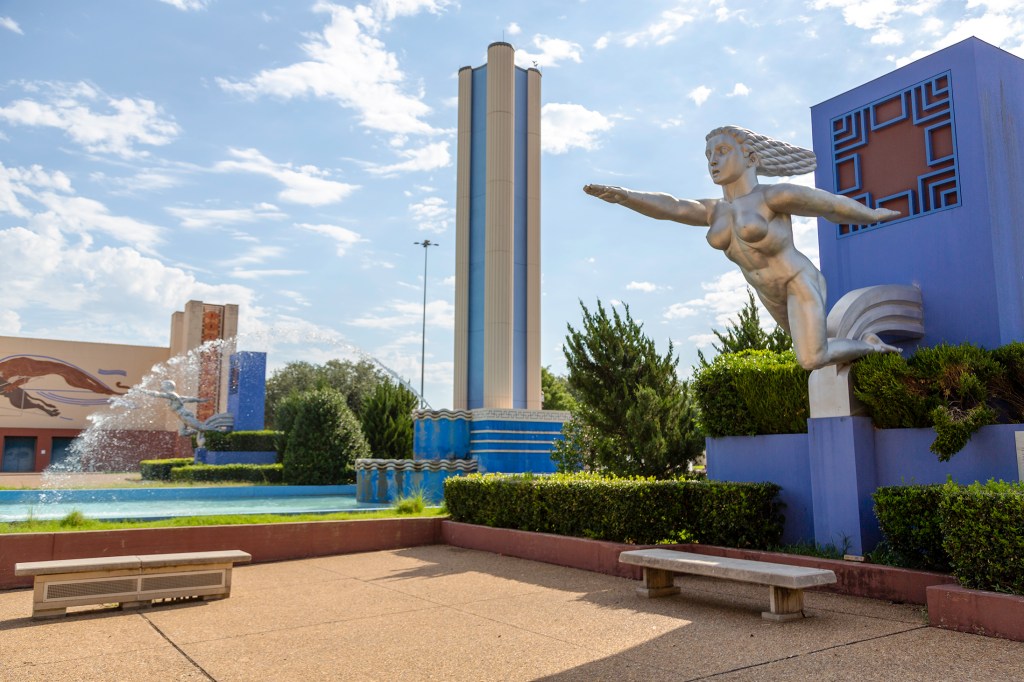
And last but certainly not least, we finally arrive at Contralto (the lowest female singing voice) toward the end of the Esplanade’s reflecting pool to the right of the Great Pylon. Her male counterpart Tenor (the highest male singing voice) is on the opposite side, but we won’t even give that dude the time of day for the purposes of this writing—sorry, dude.
As part of the fountain attached to two “Singing Towers” or the loudspeaker pylons featured at the Fair Park in 1936, Stevens created the silver-painted plaster sculptures to represent sound and celebrate the exposition’s brand-new broadcasting system. But sometime after 1938, the original sculptures were damaged and soon removed because no one wanted to foot the $100 bill to repair them. Where they ended up, we can only speculate but rumor has it that they were melted down for the war effort during the Big One.
But over 70 years later, sculptor David Newton recreated a new set of sculptures that were installed in 2009. Using historic photos of the original Art Deco sculptures as a guide, Newton’s reproductions were cast in bronze this time around and the speaker towers accompanying the sculptures were recreated in cast concrete.
And the oh-so robust Contralto—who looks like she could have jumped right out of a Tamara de Lempicka nude painting—is as daring as ever before. Even gravity is no match for her with bosom and hair alike refusing to fall as she soars forward in harmony with what’s his name on the other side.
Over 85 years after the Texas Centennial Exposition, the Founders Statue, Spirt of the Centennial, the Six Ladies of Texas, and Contralto continue to be as badass as ever. And Fair Park in Dallas wouldn’t be the same without the presence of these formidable women.
Hey, American people of Mexican descent! What do you call yourselves? You know what I mean. When people ask: “so, what are you?”. A person—I think.
Personally, I like to call myself a Browniebut when I am amongst polite society, Hispanic or Mexican-American have usually been go-to’s. Though when I think about it, Hispanic is kind of vague and I was born in America, therefore I am an American first. Why do I have to specify? I’m a god damn Yankee doodle dandy and don’t you forget it.
I could just say American of Mexican descent but I run out of breath every time I try. I’ve never referred to myself as a Latina but if other people call me that, whatever. I guess I technically fit in that category. Justdon’t call me a spicy Latina. I’m the type of Latina that quietly stews until I snap one day and reach unadulterated Bill Burr-levels of blind rage.
But I’ve been hearing the term Chicano more and more lately. And I don’t hate it. Chicano is efficient and accurately describes “what I am”: an American of Mexican descent. Once a derogatory term for us Brownies, those in El Movimientoor theChicano movement adopted the label and made it their own in late 1960s America. And that’s how it’s done. Take the power out of hateful words and reclaim them for yourself.
And right now, the story of Chicano-ness is being celebrated in two major art institutions across Dallas and Fort Worth simultaneously—and it’s not even Hispanic Heritage Month! From lowriders at the Dallas Museum of Art to political printmaking at the Amon Carter Museum, the cultural history of Mexican descendants in post-war America is center stage in North Texas.
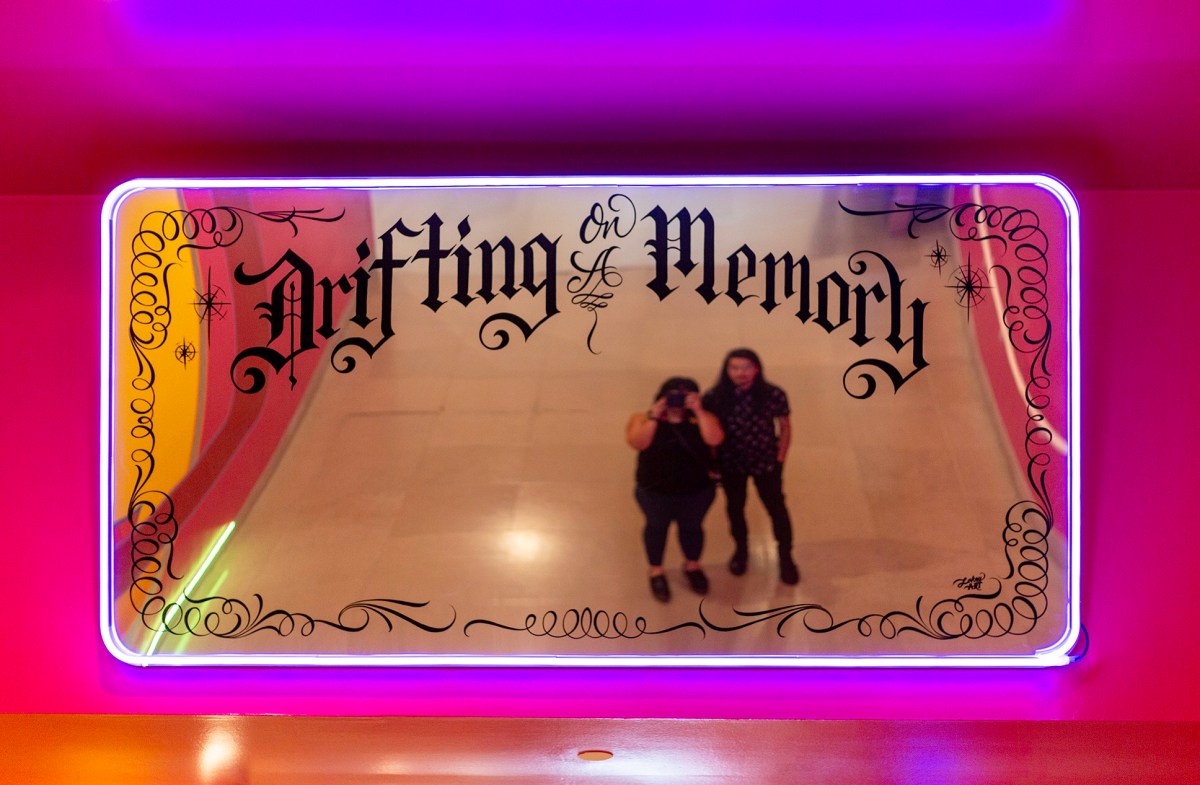
Drifting on a Memory detail
Guadalupe Rosales: Drifting on a Memory at the Dallas Museum of Art
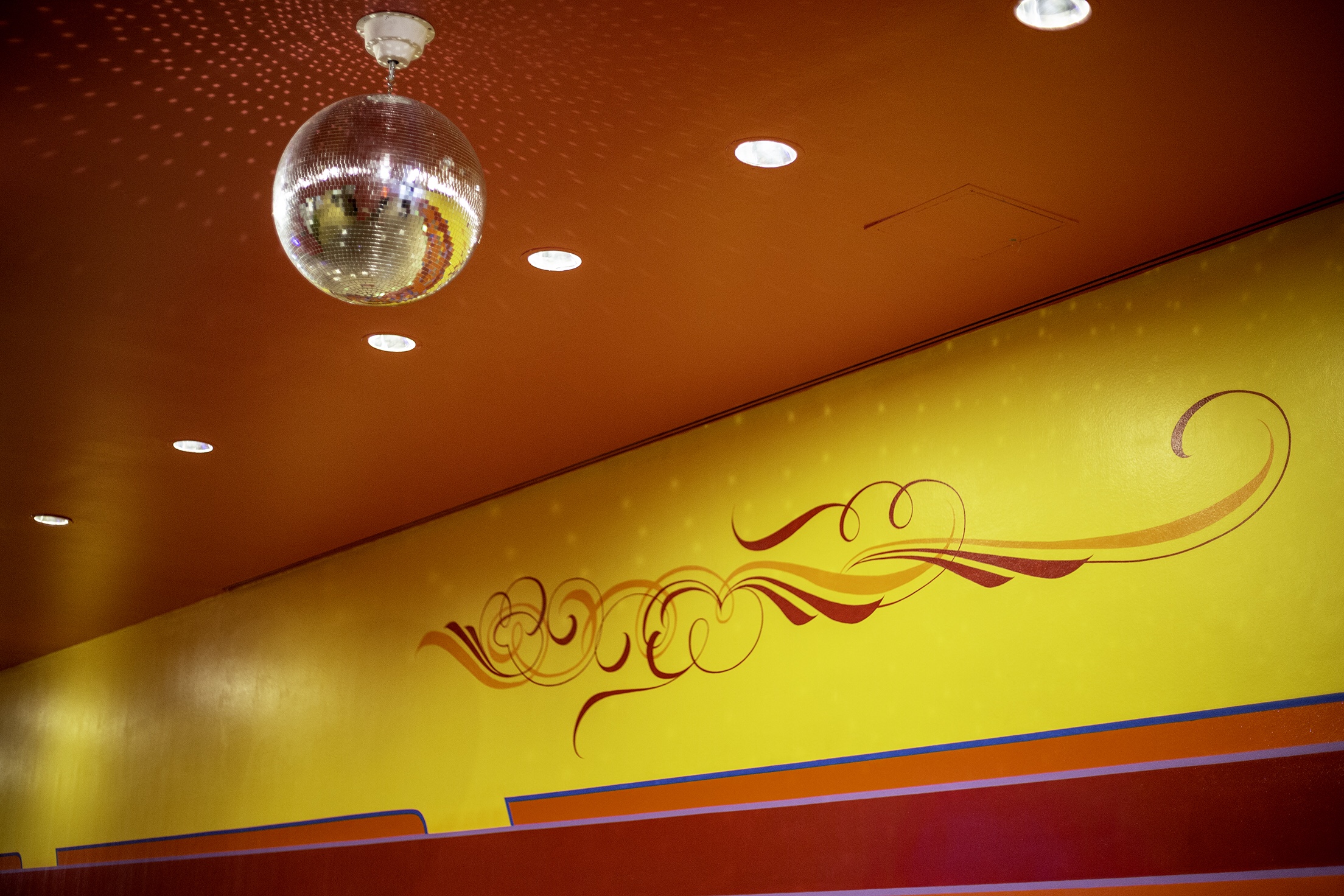
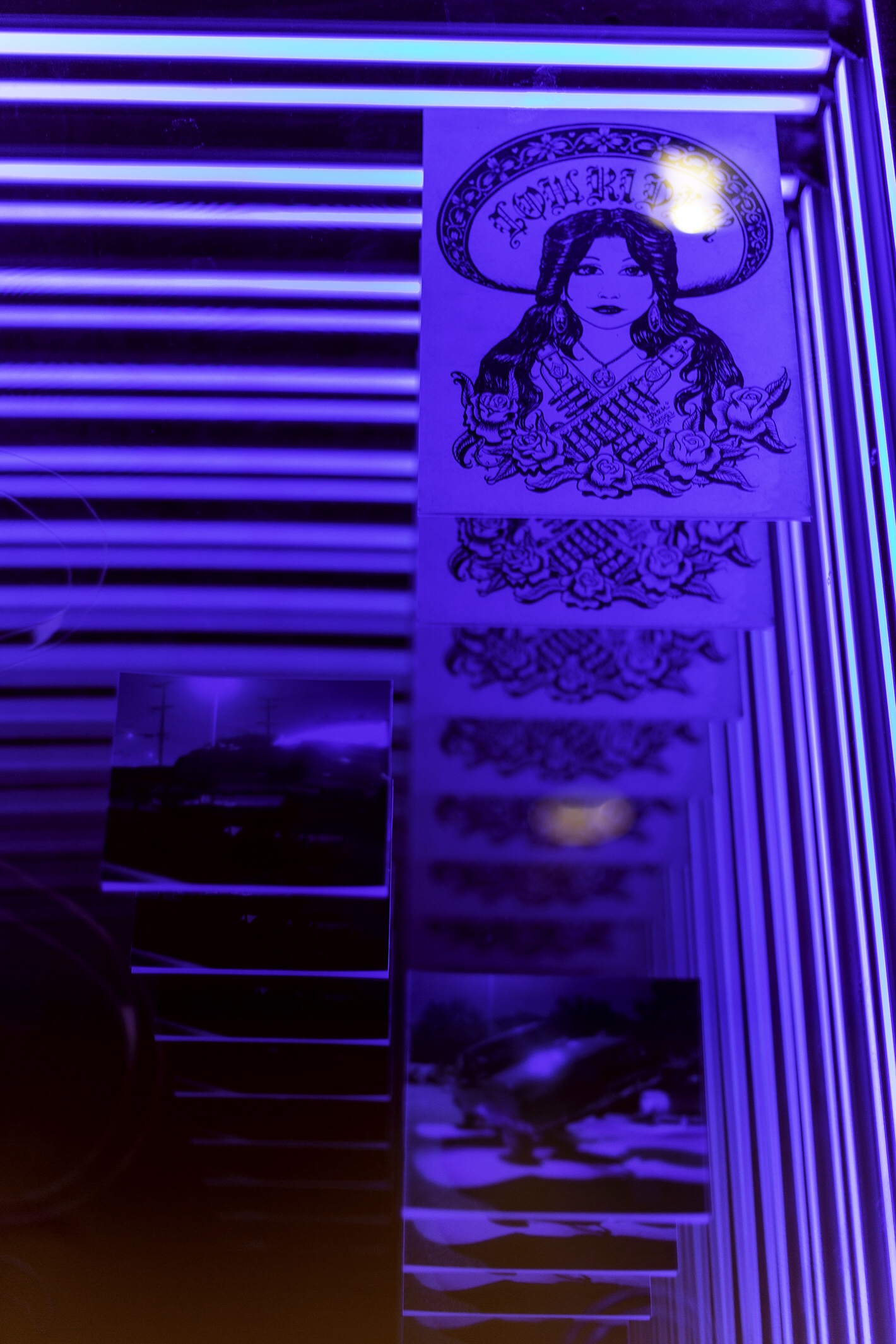
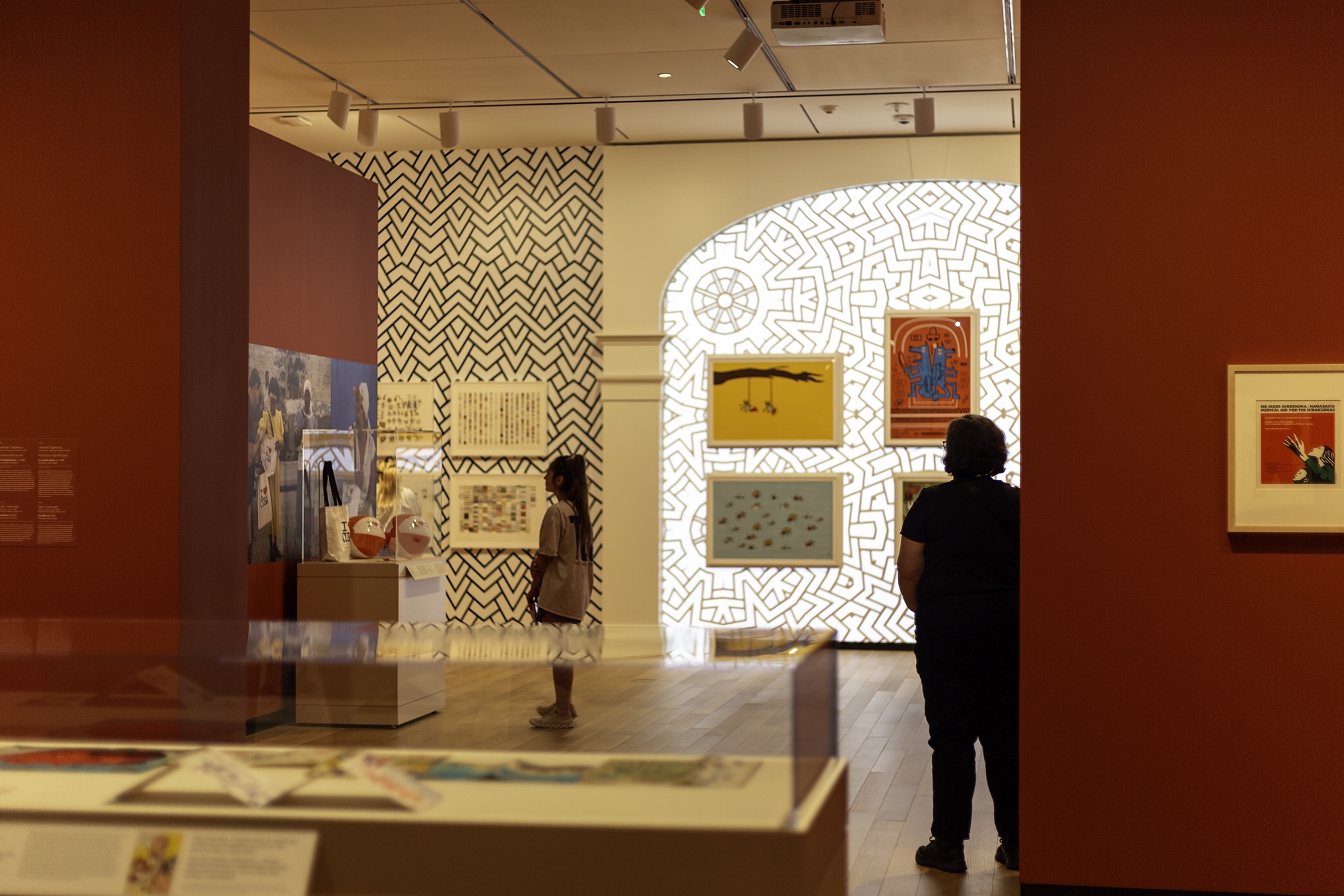
Cruising into the Dallas Museum of Art, you’ll immediately be sucked in by the bold colors of red, orange, pink, and yellow stretching down the Concourse as you enter the memory of an artist. Stop and see your own reflection in the large rearview mirror hanging above the corridor to become part of the memory yourself. Surrounded by a glittering disco ball above, vague sounds of música, and glowing lightboxes with old photos of friends and Homies figurines took me back to a time I never really knew with Guadalupe Rosales: Drifting on a Memory.
I was a kid back then but can you imagine how bumping the lowrider scene must have been in East LA during the 90s? Oh my god—the music only. Well, Los Angeles-based artist Guadalupe Rosales takes you back to that nostalgic time with help from local artists Lokey Calderon and Sarah Ayalato deliver an immersive experience and homage to lowrider culture. Naturally, this got me thinking about the history of lowriders and what they mean for the Chicano community.
Lowriding after the war
Lowriding goes back to the 1940s, extending across Mexican-American barrios from East Los Angeles to El Paso, Texas.
Cue Sleepwalk by Santo & Johnny.
It all started with young zoot-suiters self-customizing their flashy Pachuco-style cruisers, but lowriders really took off after World War II. In general, car culture boomed in America once veterans returned home with all that GI money burning holes in their pockets. And Chicano servicemen were no different—they just did it their own way.
While high-speed hot rods were all the rage at the time, lowriders celebrated that “low and slow” life among the community. Often using cheap prewar Chevrolets or Fords, Mexican-American veterans customized their own cars by lowering the rear end within inches of the pavement and usually tweaked the engines, added soft velvet upholstery to the interior, or painted the exterior with metallic candy colors and stunningly elaborate designs.
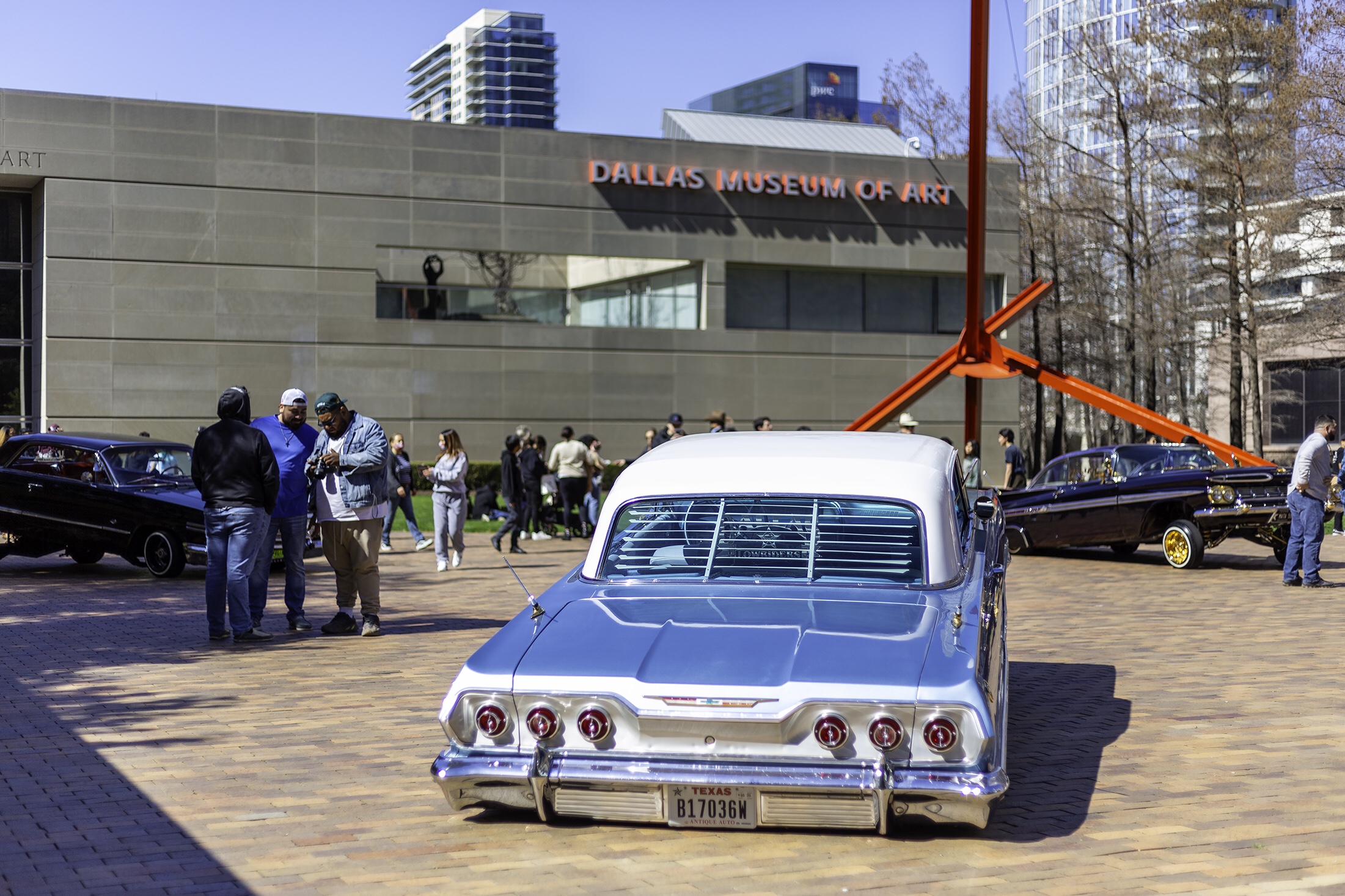
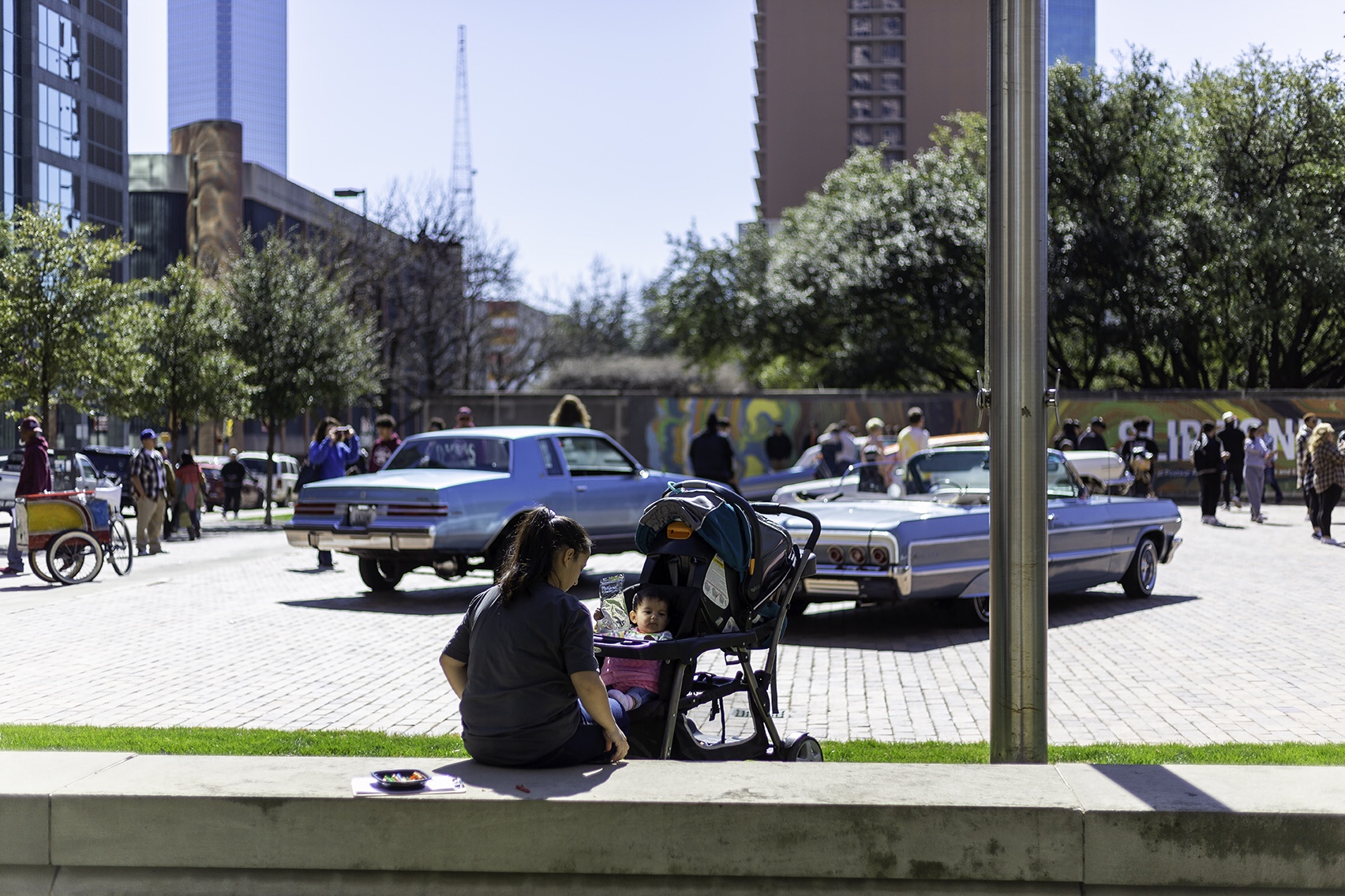
Lowriders at the DMA, 03/12/2022
Lowriders essentially became an expression of cultural pride and identity. These fly rides were (and still are) an extension of their owners and it was all about representing your individual style while cruising down the local boulevard. But honestly, it was about socializing with your community as much as it was about showing off your extravagant rolling work of art.
American car clubs have been around since the turn of the twentieth century, but by the late 1950s, customized cars began dominating the scene. In 1962, the Ruelas brothers (Julio, Fernando, Oscar, and Ernesto) opened their own club in Los Angeles called Duke’s Car Club which eventually grew into multiple chapters across the nation. It’s regarded as the oldest lowrider club that’s still in existence today, including one chapter in Japan!
Lowriders at the DMA, 03/12/2022
By this time, the civil rights movement was already in full swing and by the end of the decade, young Mexican-Americans were also getting fed up with trying to blend into a society that treated them like second-class citizens. Chicano activists advocated for social/political empowerment and celebrated their Indigenous roots as opposed to just focusing on their Spanish or European side.
Momma and baby with the lowriders, 03/12/2022
Meanwhile, lowrider car clubs also embraced the movement and even provided community services, like fundraising for the United Farm Workers (UFW) labor union. The Chicano community banded together and this was reflected in the lowrider lifestyle to the rise of political printmaking amongst Chicano artists/activists in the 1960s.
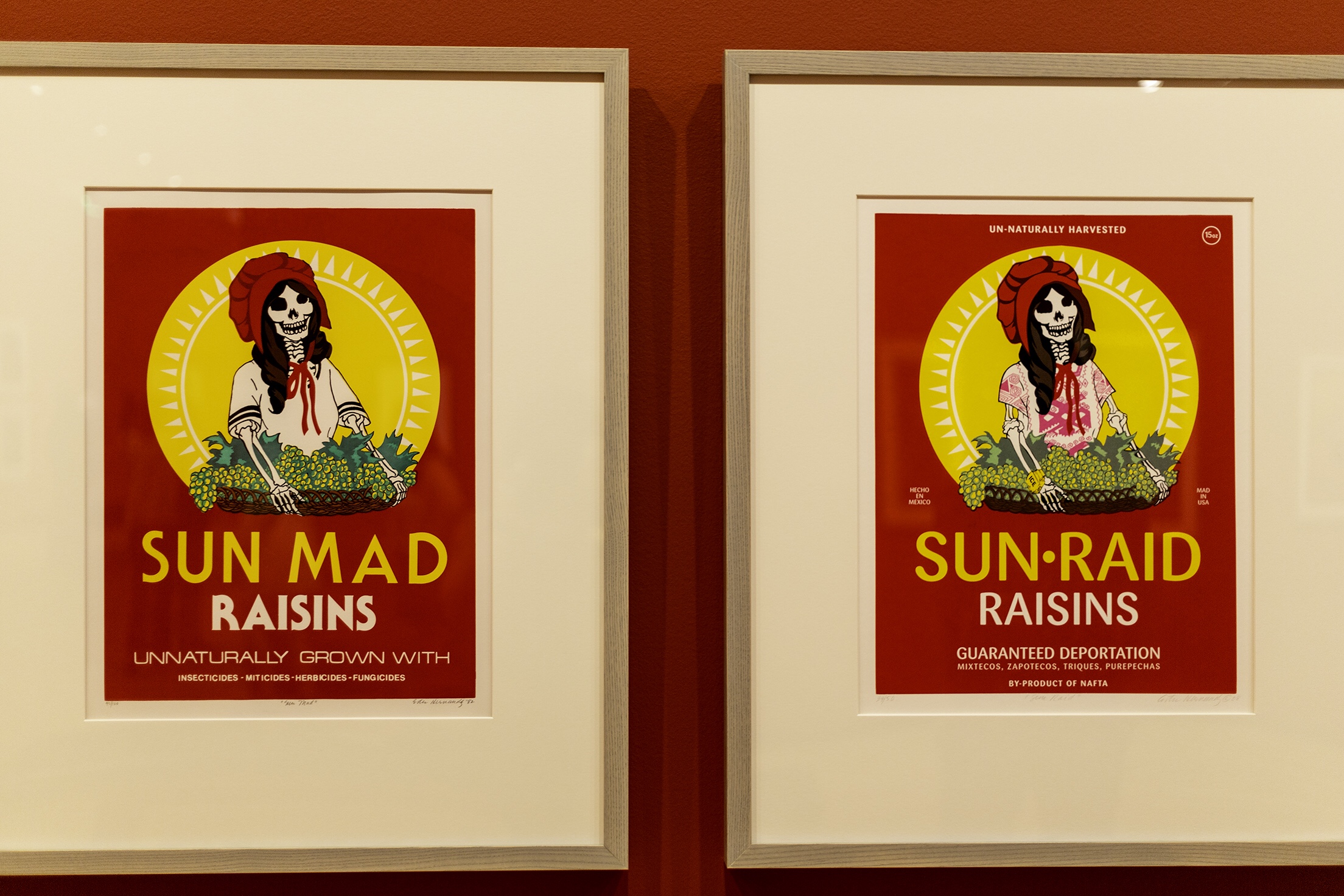
Ester Hernandez, Sun Mad, 1982.
¡Printing the Revolution! at the Amon Carter Museum of American Art
Mexican descendants are no strangers to the graphic arts. In fact, the first printing press in the Western Hemisphere was actually established in present-day Mexico City back in 1539! The printmaking tradition began with mostly religious imagery for churches, but fast forward to the nineteenth century, and printmaking—along with political discourse—further expanded among the masses with the introduction of lithography in Mexico.
I was actually lucky enough to work with rare prints by the father of Mexican printmaking José Guadalupe Posada and the following generation of Mexican printmakers José Clemente Orozco and Taller de Gráfica Popular (TGP) as an art librarian at my last library gig. Hence, the reason why I was so excited to hear about ¡Printing the Revolution! The Rise and Impact of Chicano Graphics, 1965 to Nowat the Amon Carter Museum of American Art. I eagerly walked upstairs toward the audacious red walls of the exhibition with a distinctive Emiliano Zapata detail gazing off to the side as I strolled through to see what happens when art and activism collide. Organized by Smithsonian American Art Museum curators E. Carmen Ramos and Claudia E. Zapata, ¡Printing the Revolution! features 119 prints by iconic Chicano artists, from Andrew Zermeño’s Huelga! (1966) to Ester Hernandez’s Sun Mad (1982) that demonstrate printmakings massive role in the Chicano movement.
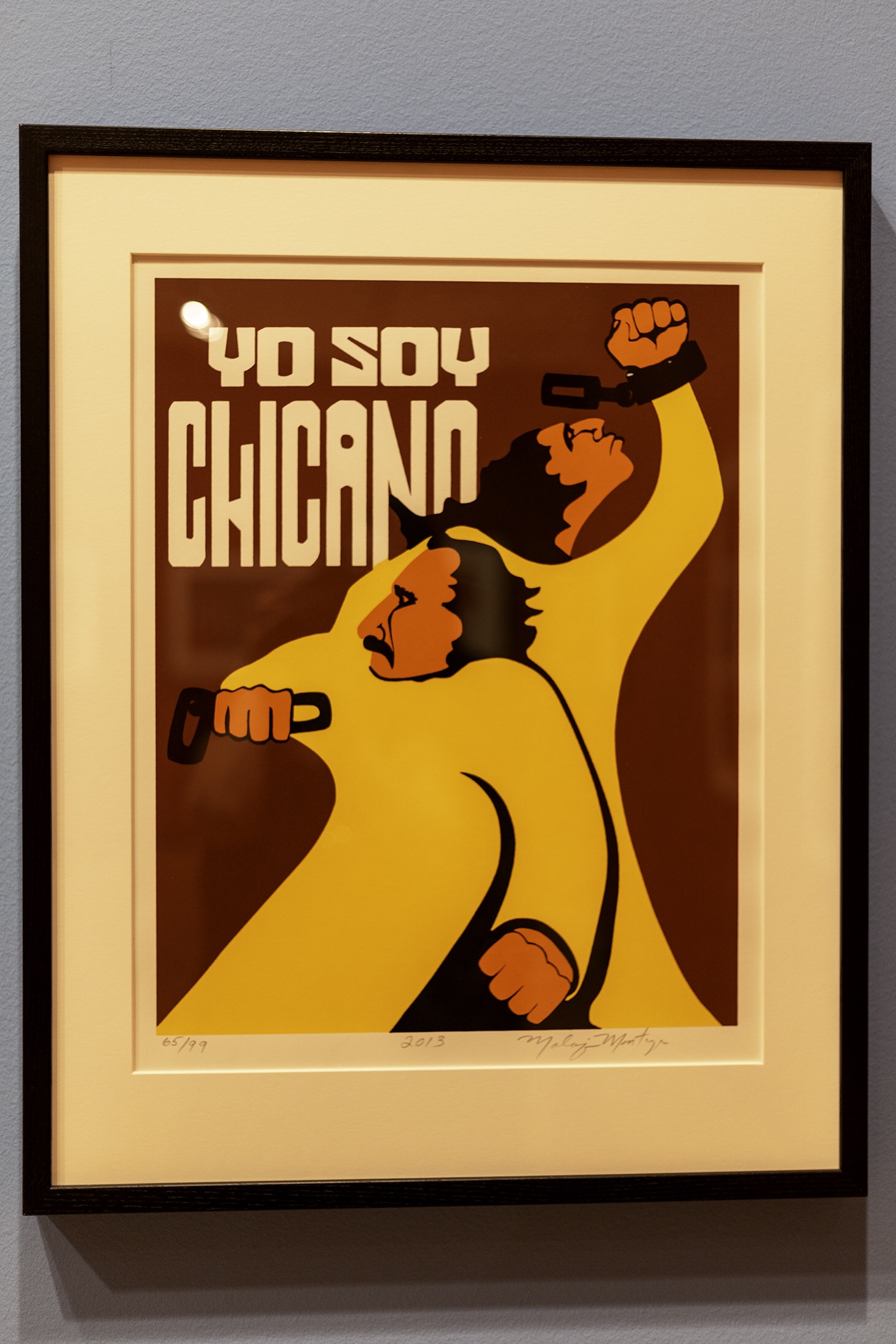
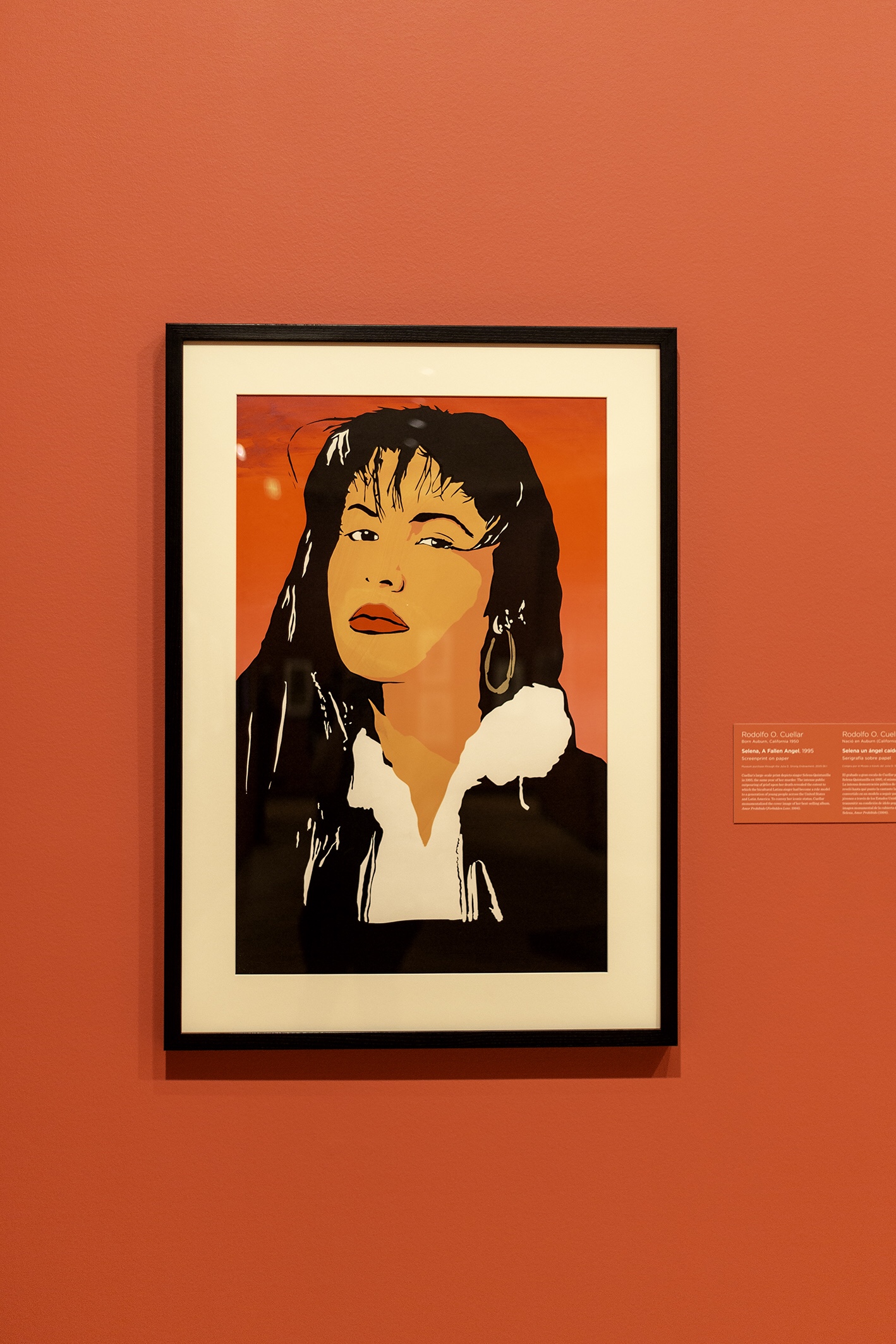
Malaquias Montoya, Yo Soy Chicano, 1972.Rodolfo O. Cuellar, Selena, A Fallen Angel, 1995.
In the 1960s, El Movimiento, also known as the Chicano movement, developed in the wake of the American civil rights movement to also demand equality in the eyes of the law and society while unifying Mexican descendants—regardless of class.
But grievances with the United States government go back to after the Mexican-American War ended. The Treaty of Guadalupe Hidalgo was signed on February 2, 1848, and the border soon crossed the Mexicans already living in what would soon become the American Southwest—from New Mexico to California. Land grants were initially promised to the Mexican people of this region but were ultimately denied when it came down to it.
So, you know how the story goes. Basically, Mexican descendants quickly began their status as second-class citizens the second the border crossed them. It took over a century for a new generation of Mexican-Americans to stand up, proudly adopt the “Chicano” label, and reject assimilation into Anglo-American culture. We have our own badass culture!
Come on—Mexican food, Mexican art, calaveras, Día de los Muertos, family, tequila, AND our ancestors come from the Aztec and Mayan Empires. We got our own stuff, okay? But, I digress.
That Posada print…
Anyway, Chicano activists opted to embrace their newfound identity while exploring their Indigenous roots. And most importantly, they mobilized like never before. Chicanos fought for the restoration of land grants, labor rights, and better educational opportunities. Key figures to come out of the Chicano movement were poet/activist Rodolfo “Corky” Gonzales and civil rights activist Reies Lopez Tijerina, along with Cesar Chavez and Dolores Huerta—co-founders of the National Farmworkers Association which later became the United Farm Workers (UFW).
Like their predecessors down south, Chicanos in America used art—specifically printmaking—to not only express cultural pride but also to call attention to the blatant discrimination they saw happening around them…
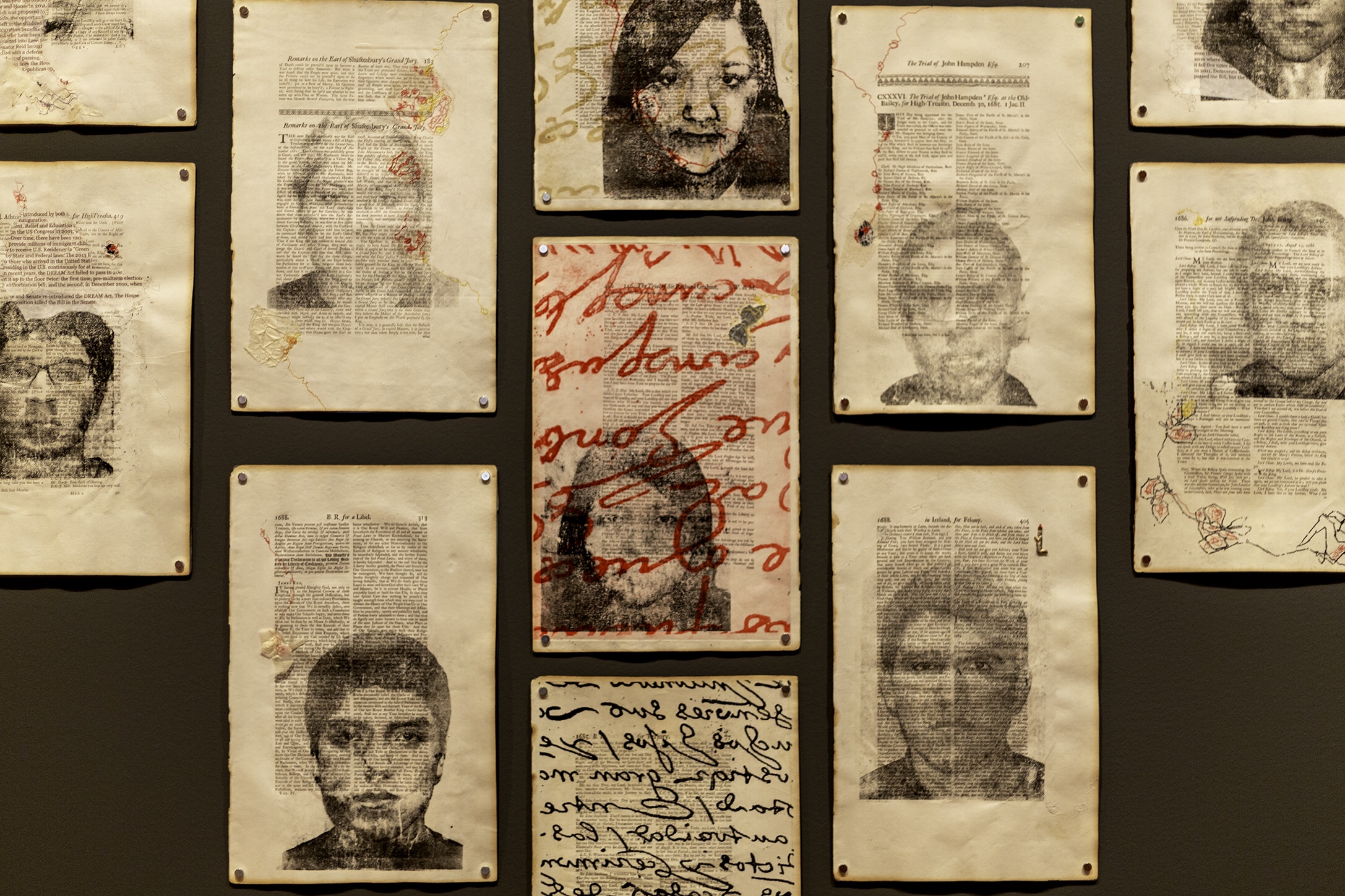
Some unapologetically declared who they were like Malaquias Montoya in Yo Soy Chicano (1972). Some called out the agribusiness for contaminated water and pesticides that affect farmworkers, consumers, and the environment as a whole like Ester Hernandez in Sun Mad (1982). Some reference how Dreamers and other undocumented immigrants are portrayed as criminials in some sectors of our society like Sandra C. Fernández in Mourning and Dreaming High: con mucha fé (2014-2018). And some just simply paid homage to other great Mexican and Mexican-American figures like José Guadalupe Posada, Emiliano Zapata, and Selena.
Sandra C. Fernández, Mourning and Dreaming High: con mucha fé, 2014-2018.
From lowriders in Dallas to political printmaking in Fort Worth, the fact that there are two major art institutions displaying a certain stretch of Mexican-American history after the war to now is pretty cool. And it’s had me reflecting on my own ancestry—on my own history. It makes me thankful for those who came before me. The ones who did the dirty work and demanded our civil rights in order to give me a relatively good life today. Nothing’s perfect, but that’s life.
Will I start calling myself a Chicano? Probably not. Mostly because I don’t like getting caught up in “labels” and I’m just not used to referring to myself that way. But also—I have a lot of fun calling myself a Brownie. We may not agree on what we call ourselves, and that’s okay. We are not a monolith. But we’re still united through our common hardships and triumphs as a people.
I think Rodolfo Gonzales said it best in his poem I Am Joaquín:
Hello, people who appreciate art! Guess, what? I quit my job!
Now I don’t want to get into it here, maybe in a future memoir once I gain enough power.
It’s a joke, y’all…
But I will say that for the first time in a long time—I feel good. I feel like I finally know what I want for the most part. Let’s be real: things change, people evolve (hopefully). Who really knows, right? The future is uncertain and that’s the great beauty and tragedy of life.
With that said, I for sure know what I DON’T WANT, and most importantly, I’ve realized my time is valuable. I’m 34. I’m not getting any younger. And frankly: I’m just sick of the bullshit.
So with that elegant statement, I’m here to say that I’ve decided to go rogue and become a freelance writer.
I realize that we’re on the brink of World War III, but humor me here.
If you’ve ever read my blog posts as an art librarian for Dallas Public Library, you know I love writing about the lives of artists and their work. The whole research process honestly fills me with such great joy. What can I say? I have fun learning new things and understanding the minds of creatives throughout the course of human history.
Well, I’m going to keep doing that but on my own terms now. I’ll still write about the history of art around Dallas (because that’s my hood) but also about whatever the hell else I want to talk about as it relates to art. I’m also interested in comedy, politics, and the culture at large, so anyway I can insert these other areas into the discussion: I will.
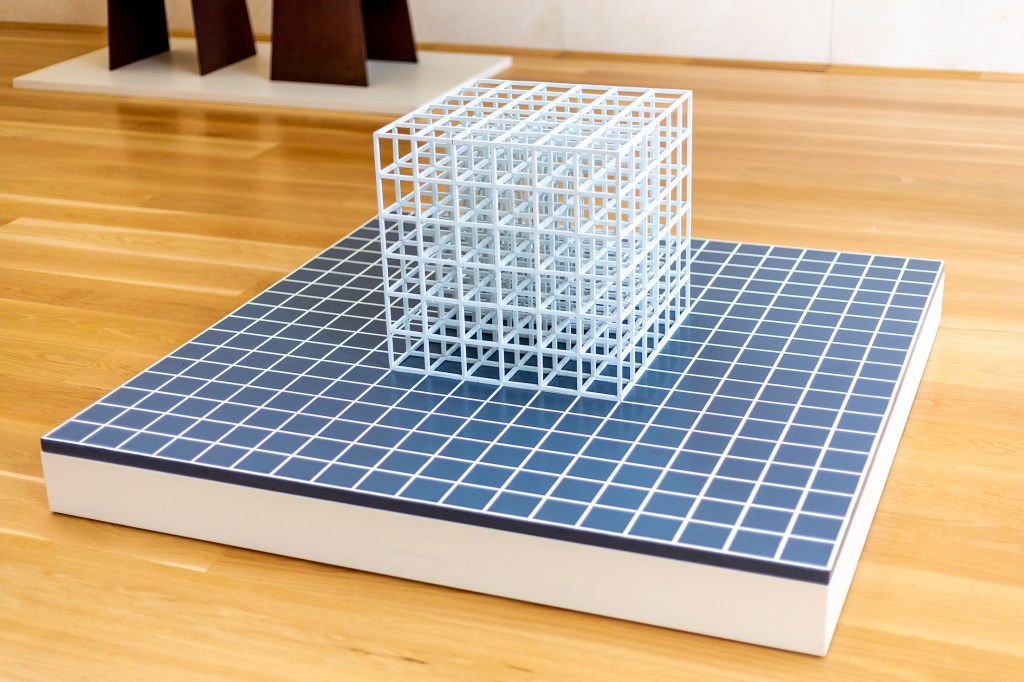
I love that a single work of art can tell a story of a particular time and place of a particular people. Like Sol LeWitt, I just want to follow the ideas that interest me most.
I’m currently reading his biography Sol LeWitt: A Life of Ideas by Lary Bloom and he basically redefined the definition of what art meant up to that point in the late 1960s. The idea itself took precedent over the final execution of the artwork.
The conceptual artist was also a deeply kind, witty soul. He was known for his friendship with Eva Hesse, another pioneering figure at that time who didn’t always get the respect she deserved. She was a woman in the 1960s trying to make it in a male-dominated field, so you get what I’m driving at.
She struggled, as has been documented in her Diaries, but she was also courageous, ambitious, and oh so talented. And Solly knew this.
Here’s the first paragraph of an inspirational letter he sent to her once:
“Dear Eva,
It will be almost a month since you wrote to me and you have possibly forgotten your state of mind (I doubt it though). You seem the same as always, and being you, hate every minute of it. Don’t! Learn to say “Fuck You” to the world once in a while. You have every right to. Just stop thinking, worrying, looking over your shoulder, wondering, doubting, fearing, hurting, hoping for some easy way out, struggling, grasping, confusing, itching, scratching, mumbling, bumbling, grumbling, humbling, stumbling, numbling, rumbling, gambling, tumbling, scumbling, scrambling, hitching, hatching, bitching, moaning, groaning, honing, boning, horse-shitting, hair-splitting, nit-picking, piss-trickling, nose sticking, ass-gouging, eyeball poking, finger-pointing, alleyway-sneaking, long waiting, small stepping, evil-eyeing, back-scratching, searching, perching, besmirching, grinding, grinding, grinding away at yourself. Stop it and just DO!”
I’ve been Eva Hesse and we all need someone like Sol LeWitt in our corner. I like his overall message of just saying fuck the noise, do what you need to do. So that’s what I’m trying to do!
I’ve always been kind of a generalist when it comes to art history. People ask me what my focus is, and I always want to say: “um, all of it”?
Like Pocahontas, I tend to go where the wind blows. From ancient history to now, my interests are all over the map, as I assume my writing may be. Not to sound grim, but honestly, I prefer my artists dead. Why? Because I can dig further into the past and present what may have been long forgotten. It’s so important to discuss the past, as the great George Orwell once said: “who controls the past controls the future”. Never forget, my friends.
So, what’s up with the blog name—Nature Morte: Stories Through Art? (updated to Nature Morte: Art History for the Rest of Us as of January 7, 2023. Let’s see if it sticks!)
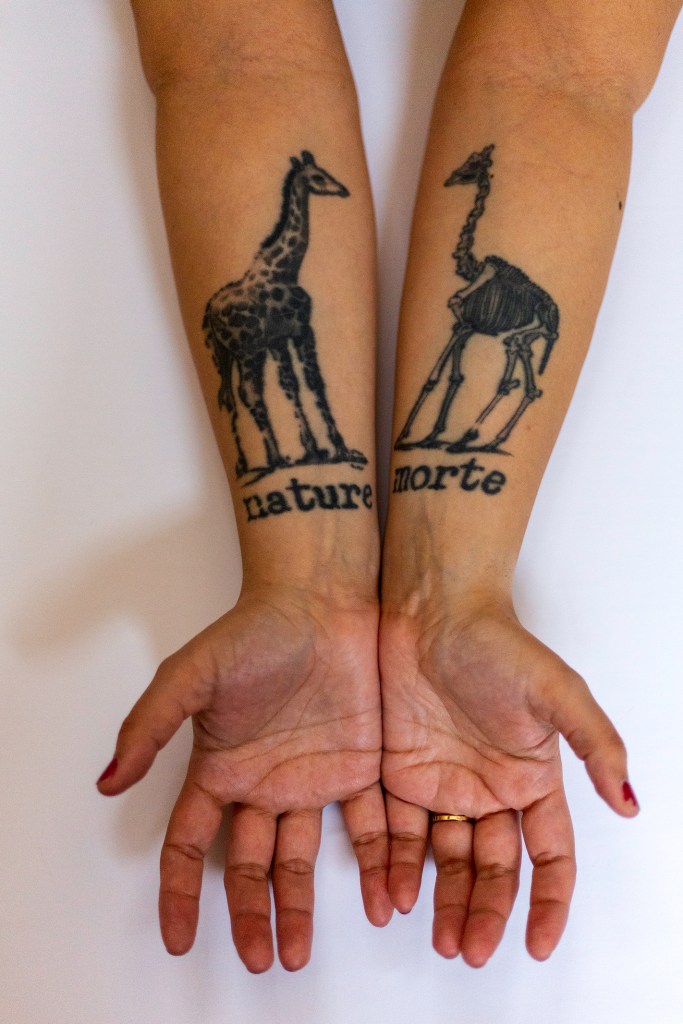
The term nature morte, French for literally “dead nature” was used in the 19th-century to describe still life paintings. And it’s a term that has always intrigued me. So much so that I actually branded myself with it when I was about 20 years years old.
Photo: Jose Sarmiento
I first learned of nature morte in a 19th-century American Art course I took in college. We learned of the hierarchy of paintings in Europe as opposed to America at that time. While history paintings reigned in Europe, landscapes (because we had to be different) dominated in America. However, poor, lowly still life paintings or nature morte was dead last either way.
Maybe it’s because the word DEAD is in it. Maybe it’s because I’ve always rooted for the underdog. But mostly, it’s because I’ve seen some absolutely breathtaking still lifes in my day.
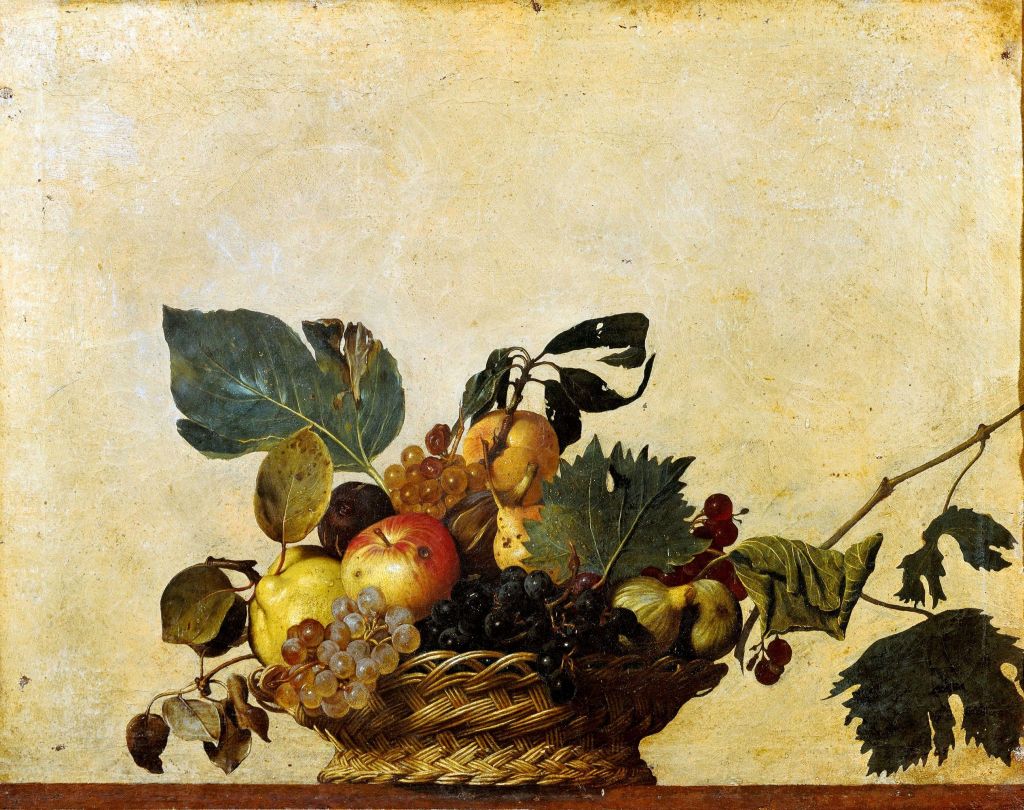
Michelangelo Merisi da Caravaggio, Basket of Fruit, c. 1599.
Come on, how can fruit be so hauntingly beautiful and delicious all at once?
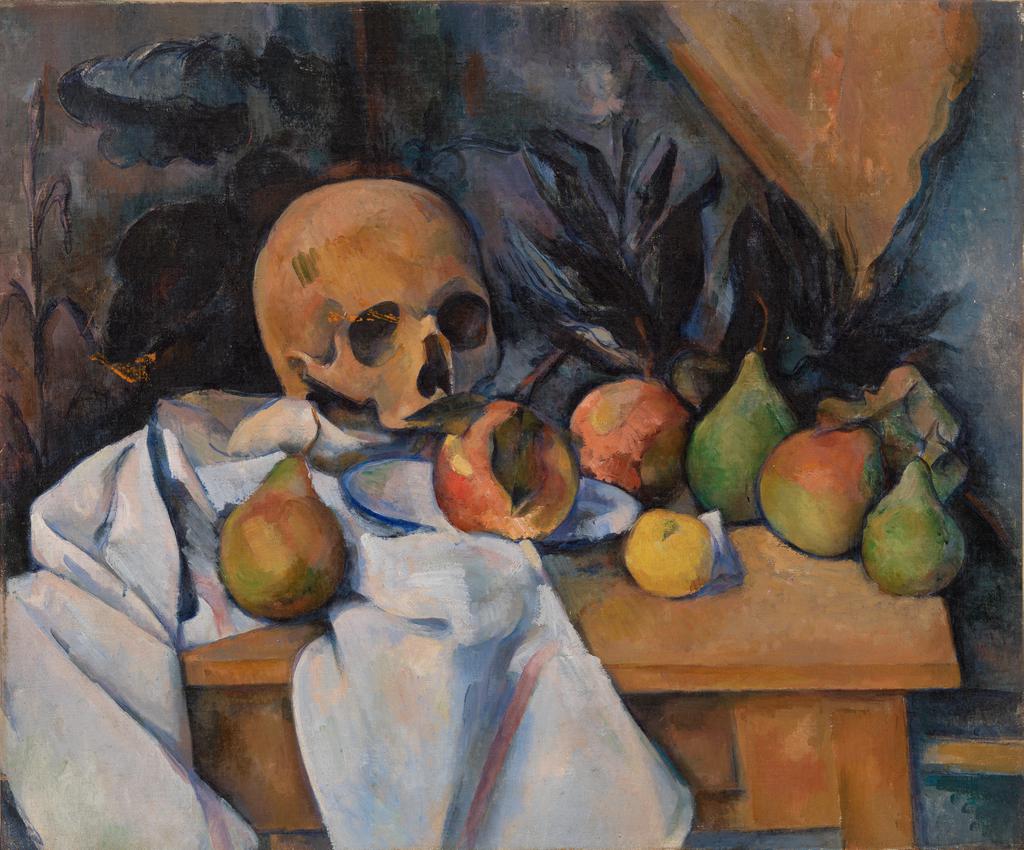
Besides the standard flowers and fruit, artists also put literal morte into their work.
Paul Cézanne, Still Life with Skull (Nature morte au crâne), c. 1890-1893.
I dig it when beauty and the macabre unite. So, that’s what’s up with the name and I’d love to write about the history of nature morte in art in a future (few) posts. Stay tuned!
In addition to art blogging, which obviously won’t pay the bills on its own, I’m also out there freelancing my wordsmith talents to other industries as well. Hey, a girl’s got to eat. I actually have a great writing gig right now (my first!) and you can learn more about it on my About page.
So, writing is my business now and I couldn’t be happier. It’s been something I’ve explored and enjoyed since a young age, but I finally got the courage to pursue it. Nothing like hitting rock bottom in order to get your priorities straight. I might go broke doing it, but it’s a risk I’m willing to take.
I love libraries and they will always be a part of my world as well. Kind of required for all that fun research I will be doing.
If you’re interested in art, history, and possibly a lot of dumb things in between—here I am.















 Mariza Morin